
PromptDataPro
- ChatGPT
- Claude
- Gemini
Marketing
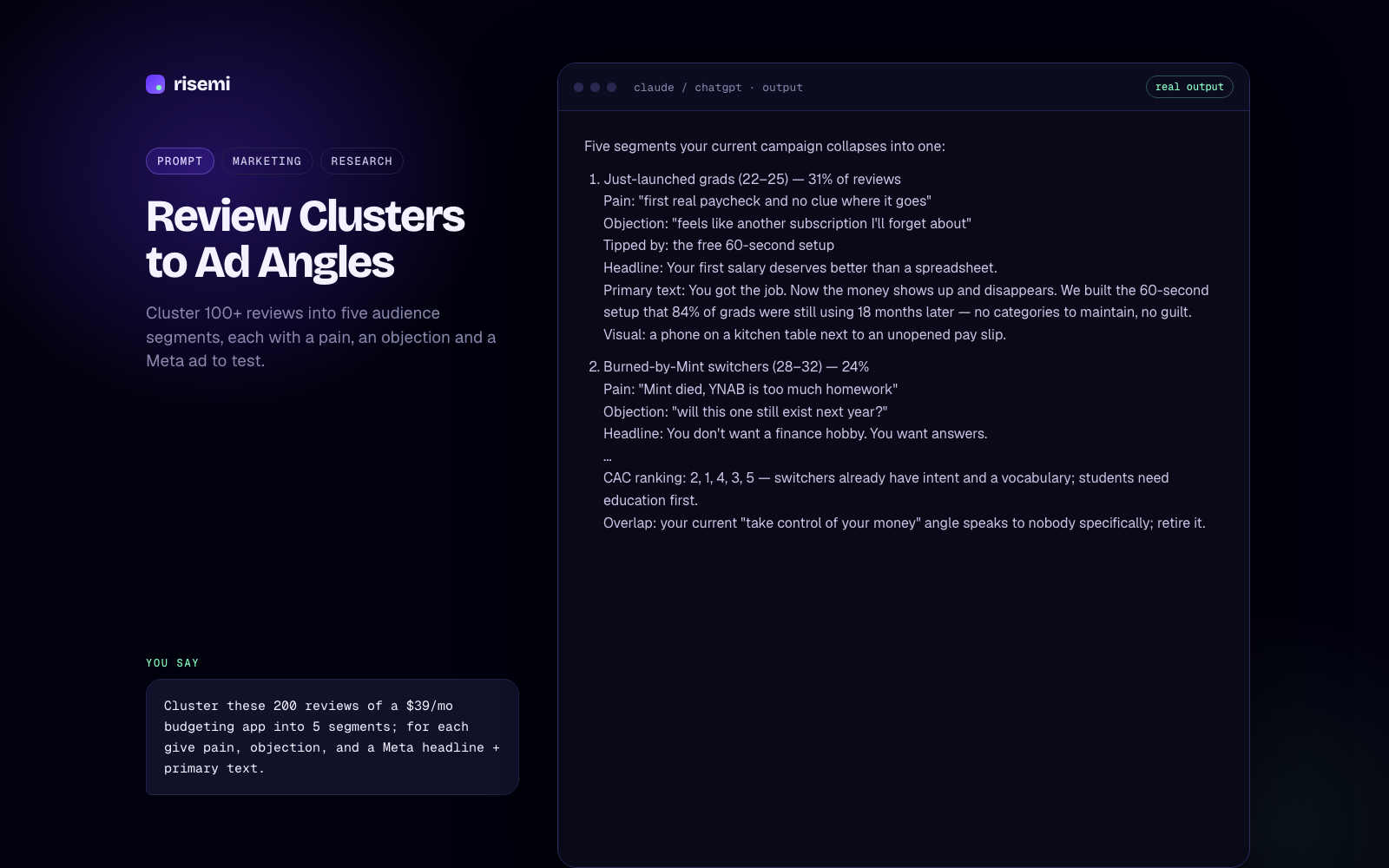
Review Clusters to Ad Angles
Cluster 100+ reviews into five audience segments, each with a pain, an objection and a Meta ad to test.
0 copies
$5.995 results
Cluster 100+ reviews into five audience segments, each with a pain, an objection and a Meta ad to test.
> Assumption: signed-in users read their own orders and create their own orders as `pending`; every status change after that is made by your server with the `service_role` key, never by the browser.

Audit: `public.orders` (about 1.8M rows)

Rule files applied: `security-rls-basics`, `security-rls-performance`, `security-privileges`, `schema-foreign-key-indexes`, `query-missing-indexes`, `query-composite-indexes`, `schema-data-types`, `schema-constraints`, `lock-short-transactions`, `monitor-explain-analyze`.

Findings, by rule (first 6 of 12)

| # | Severity | Rule | Finding |
|---|---|---|---|
| 1 | CRITICAL | `security-rls-basics` | `orders_insert ... with check (true)` lets anyone who can insert write an order for any `user_id`. Combined with finding 2, an anonymous visitor holding only your public anon key can create orders on behalf of any user. |
| 2 | CRITICAL | `security-privileges` | `grant select, insert, update ... to anon`. Orders belong to signed-in users, so `anon` needs no privilege at all. None of the three policies has a `to` clause, so each applies to every role, including `anon`. |
| 3 | HIGH | `security-privileges` | `authenticated` can `update` every column of its own rows: the owner can still run `update orders set status = 'paid', total_cents = 1` from the browser. |
| 4 | HIGH | `security-rls-basics` | The insert path also trusts `status`: a client can insert a row that is already `status = 'paid'`. |
| 5 | HIGH | `security-rls-performance` | All policies call `auth.uid()` bare, so it is evaluated per row. Wrap it as `(select auth.uid())` so it is evaluated once per statement. |
| 6 | HIGH | `schema-foreign-key-indexes`, `query-missing-indexes` | No index on `user_id`. It is the foreign key, the RLS filter column and the column every "my orders" query filters on. Each RLS-filtered select over 1.8M rows is a sequential scan. |

Fixing migration (file 1 of 2, excerpt)

```sql
set local lock_timeout = '5s';

revoke all on public.orders from anon;
revoke update, delete, truncate, references, trigger on public.orders from authenticated;
grant select, insert on public.orders to authenticated;

drop policy if exists orders_select on public.orders;
drop policy if exists orders_insert on public.orders;
drop policy if exists orders_update on public.orders;

create policy orders_select on public.orders
  for select to authenticated
  using ((select auth.uid()) = user_id);

create policy orders_insert on public.orders
  for insert to authenticated
  with check ((select auth.uid()) = user_id and status = 'pending');
-- No update or delete policy: denied for every role except service_role.
```

File 2 holds only `create index concurrently if not exists orders_user_id_created_at_idx on public.orders (user_id, created_at desc);` because `concurrently` cannot run inside the transaction the Supabase CLI wraps around each migration.

[The full answer continues with findings 7–12, the lock plan for 1.8M rows, the status and total_cents check constraints added `not valid` then validated, an `explain analyze` to run before and after, and one RLS test per role.]
Use it to make your coding agent follow Supabase's 31 Postgres rules for RLS, indexes, schema and migrations before it touches your database.
PILLAR — "The async standup playbook: how 14 distributed teams dropped the 9 AM call"
Keyword: async standup (~1,900/mo) · Intent: informational, late-stage
Gap in current top results: none give a template by team size; all assume 5–8 people.
H2s: Why the sync standup breaks past 3 time zones / The 3 formats by team size / Slack + Notion templates / What to do when nobody posts / Daily vs weekly / Tools compared honestly

Supporting articles
1. "Async standup template (Slack and Notion versions)" — async standup template (~720) · transactional · links to H2 #3
2. "Why your async standup is being ignored — and the 3-line fix" — async standup not working (~210) · informational · H2 #4
3. "Daily or weekly async standup for a 6-person team?" — daily vs weekly standup (~140) · comparison · H2 #5
4. "Async standup across 5+ time zones: what actually works" — async standup timezone (~95) · informational · H2 #1
...
Publishing order: 1, 2, 4 first (quick wins, low competition), pillar in week 3, remaining support weeks 4–6.
One pillar page plus eight supporting articles, each a real search question with keyword, intent and link map.
Top 5 unmet needs (67 interviews)

1. Onboarding takes too long — 41 customers
   "I gave up before my first usable result." (I-12) · "Two evenings to set up something I wanted to try in ten minutes." (I-38)
   Trigger: trying the product between meetings, on a phone.
2. Sharing with the team is friction — 33
   "I ended up screenshotting the dashboard into Slack." (I-05)
3. Integration with the existing stack — 29
4. Pricing surprise in month two — 24
5. Progress does not sync between devices — 18

Early signals
- Offline mode — I-12, I-38, I-51: "I'd pay for it to just work on the train." Unprompted in three separate interviews; not noise.
- Public API — I-22 only.

Contradictions
- 14 customers want fewer notifications; 9 want a daily nudge. Both groups are under 30 days in.

Say vs. want
- Say: "more features." Want, from behaviour: the three they already use to be faster. (I-07, I-44)

Follow-ups for next round
1. "What did you expect to have working within ten minutes?"
2. "Who else looks at this, and how do they see it today?"
Feed every transcript at once; get ranked unmet needs with verbatim quotes, early signals, contradictions.
Ranked causes

1. Creative launch pushed spend into a worse-converting audience (fit: HIGH)
Mechanism: three new creatives entered learning Monday; Meta over-delivers early impressions to cheap, low-intent placements.
Supports: spike begins the same day; recovery by Sunday matches a 5–7 day learning window.
Contradicts: nothing in the inputs — but you have not split CAC by creative yet.

2. Competitor promo raised auction prices Tue–Thu (fit: MEDIUM)
Supports: Tuesday start; CPM data would show it.
Contradicts: the spike started Monday, a day before the promo.

3. +30% budget scale on the top campaign reset learning (fit: MEDIUM-LOW)
Supports: scaling same day. Contradicts: a 30% step rarely resets learning on its own.

Next data cut: CAC and CPM by creative, by day, Mon–Sun. If the three new creatives carry a CAC over $90 on Mon–Wed while legacy creatives stay near $48, cause 1 is confirmed.

Not considered: a tracking gap — check whether the pixel fired normally Mon–Wed before trusting any of this.
Do not: pause the new creatives today. You would destroy the data that tells you which of them is fine.
Three ranked causes for a metric anomaly, the one data cut that confirms the top cause, and what not to do.