
PromptTextPro
- ChatGPT
- Claude
Ops✦ Risemi pick
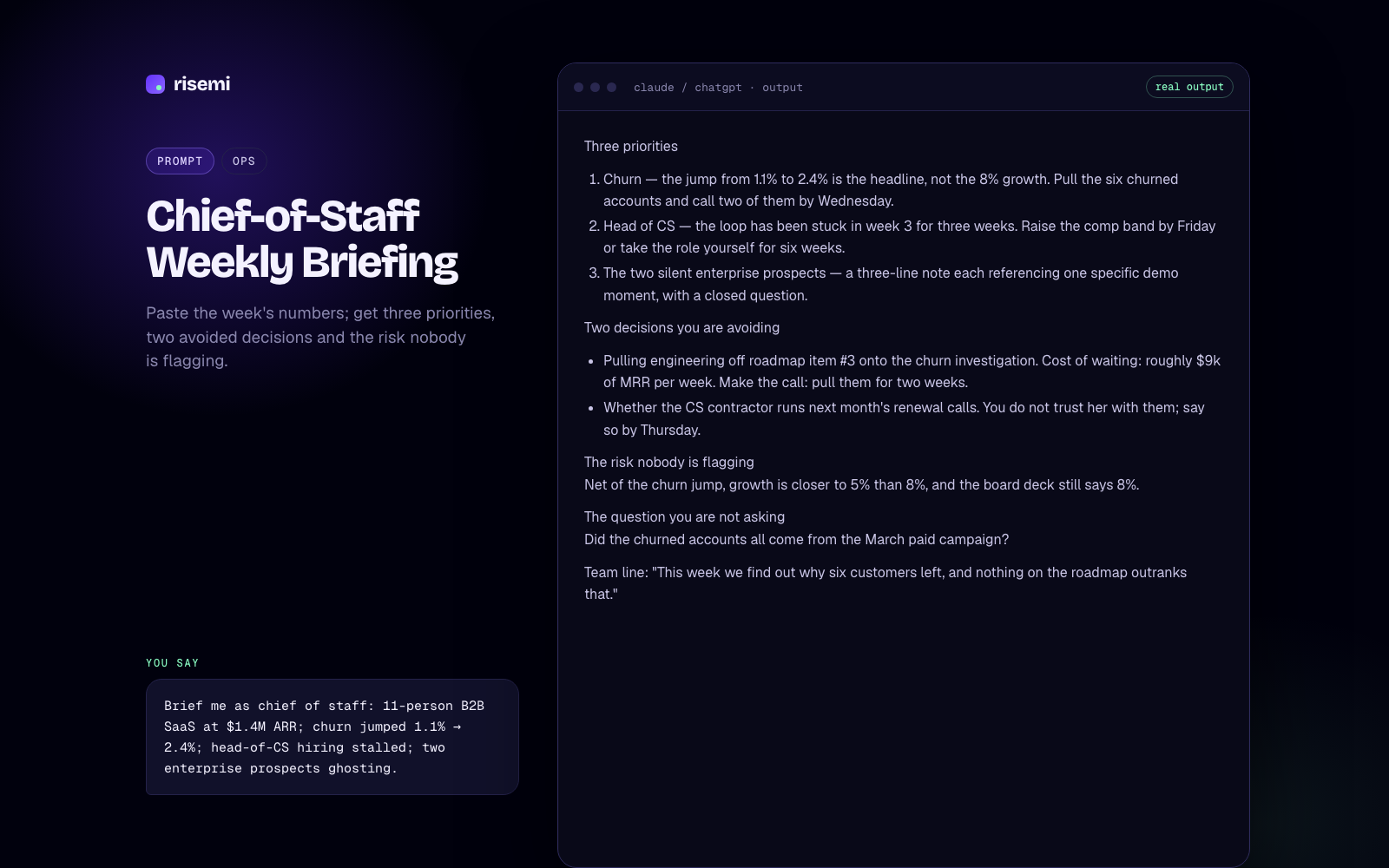
Chief-of-Staff Weekly Briefing
Paste the week's numbers; get three priorities, two avoided decisions and the risk nobody is flagging.
0 copies
$5.9915 results
Paste the week's numbers; get three priorities, two avoided decisions and the risk nobody is flagging.
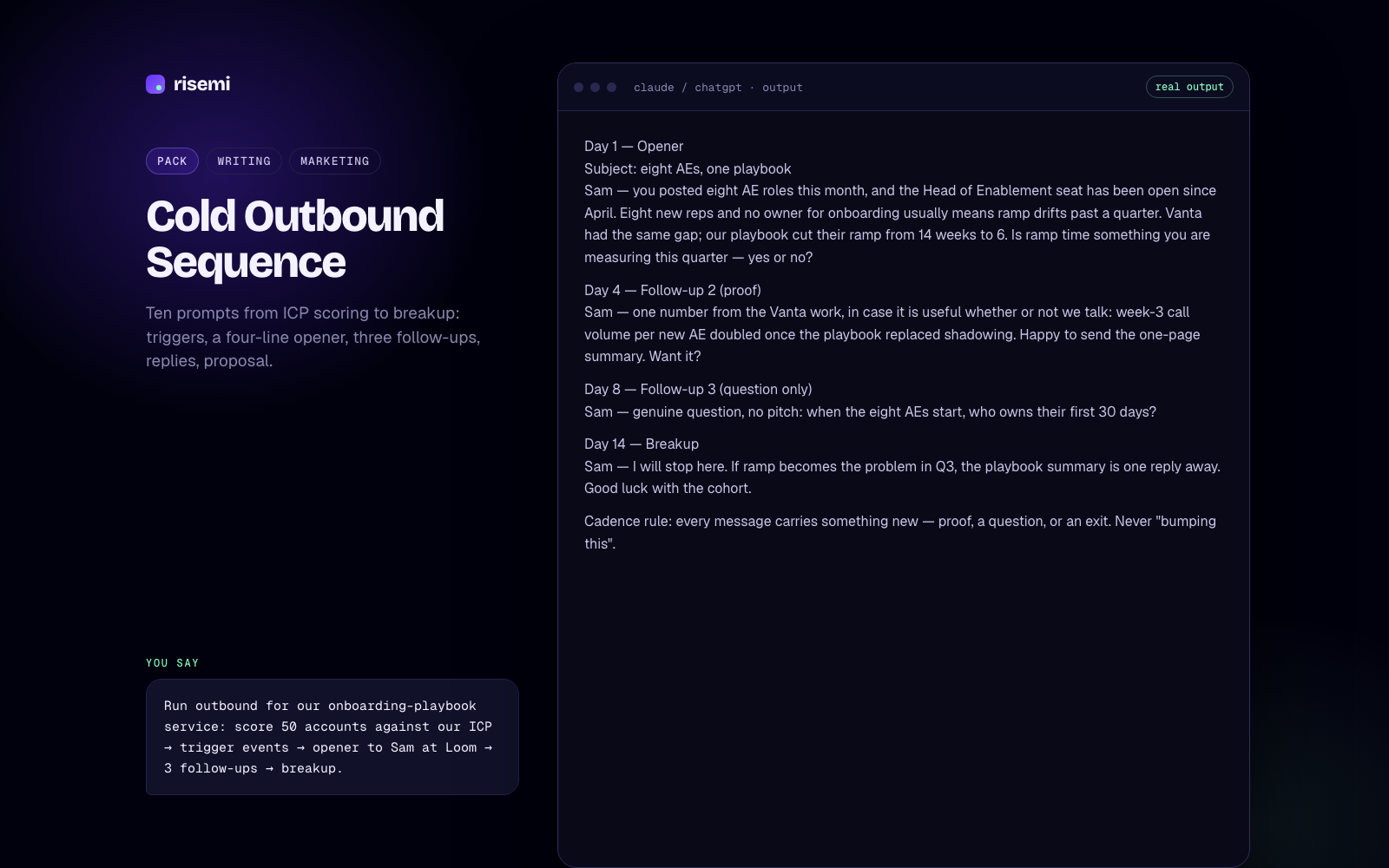
Ten prompts from ICP scoring to breakup: triggers, a four-line opener, three follow-ups, replies, proposal.
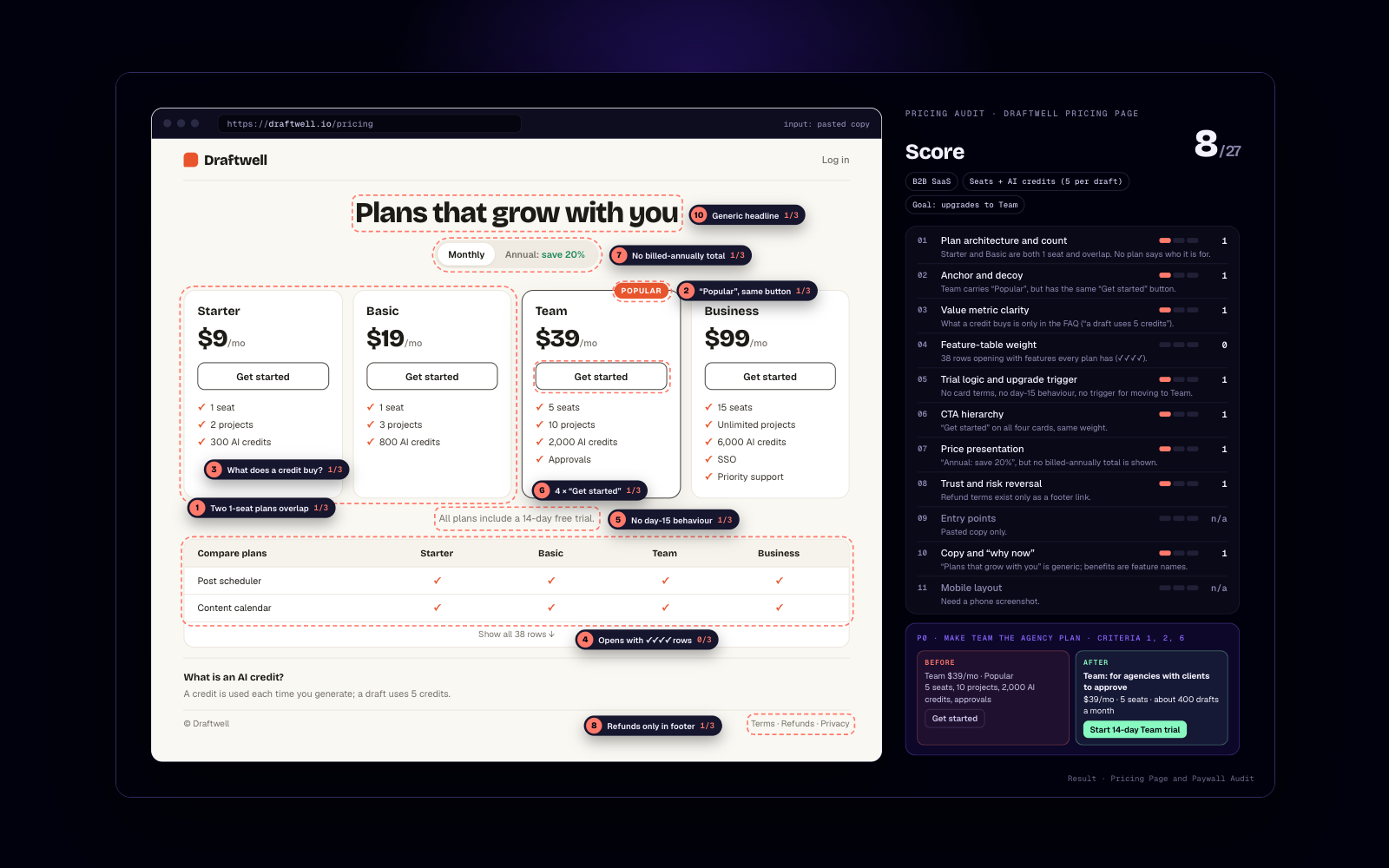
Use it to score a pricing page or in-app paywall on eleven criteria and get three ranked fixes with rewritten copy and one experiment to run.
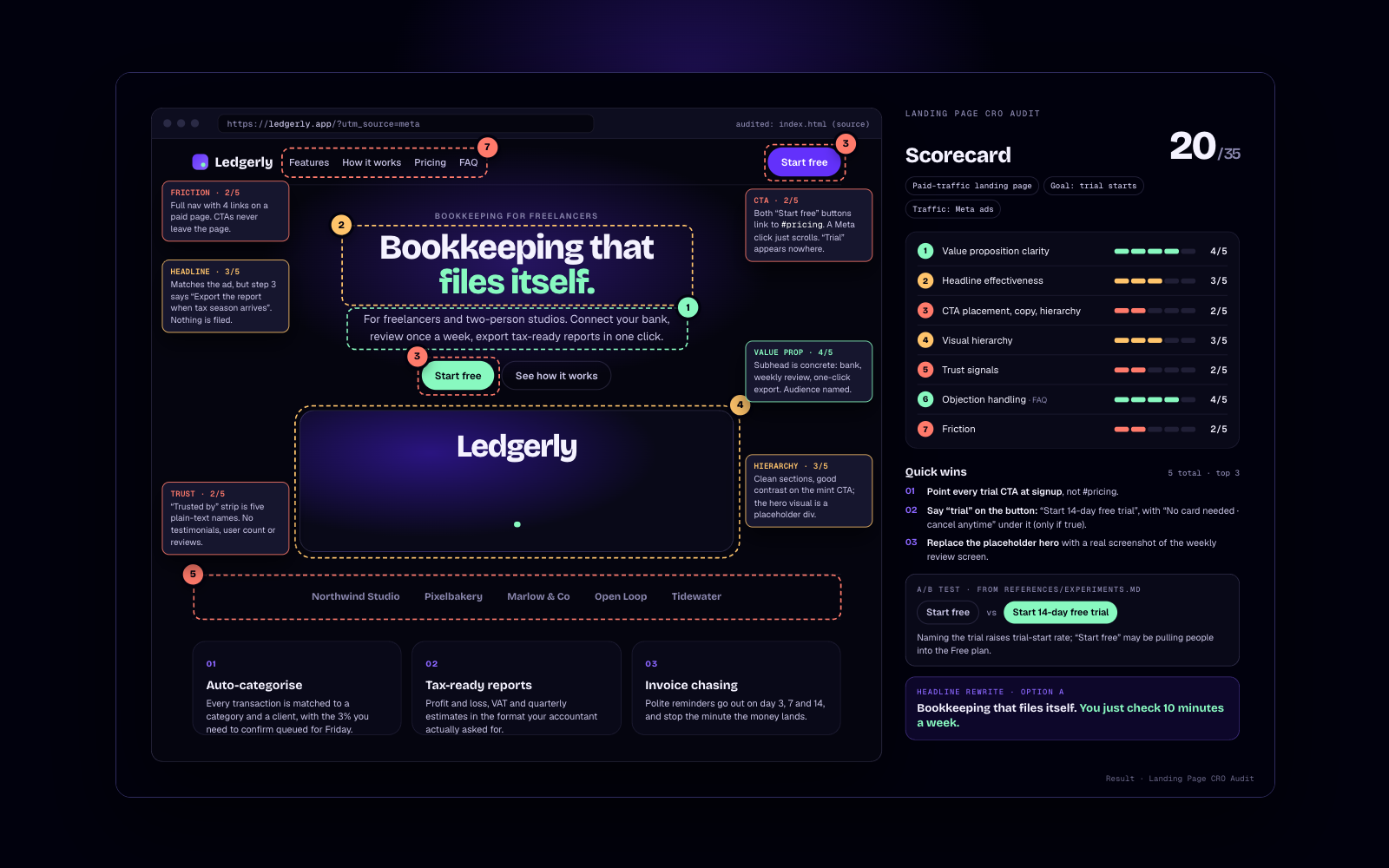
Audit a live page that isn't converting: a 7-point scorecard, quick wins, test ideas and before/after copy.
Short answer: ChatGPT can't recommend Ledgerly, because nothing it can retrieve says Ledgerly exists. Even after launch, a single landing page is not enough. A "best X for Y" shortlist comes from web-wide consensus (reviews, roundups, forums, press), not from your own site.

Visibility ladder (retrieved → cited → mentioned → recommended)
| Rung | Ledgerly today | What governs it |
|---|---|---|
| 1. Retrieved | No: not live, not in Bing's index (ChatGPT search draws from a Bing-based index) | Being indexed and crawlable |
| 2. Cited | No | Extractable, factual, fresh pages |
| 3. Mentioned | No | Entity recognition; the web talking about you |
| 4. Recommended | No | Aggregate third-party consensus, largely independent of your own content |

Source pool (one web search for the exact query, 2026-11-07; not a ChatGPT answer): only third-party roundups and affiliate lists (NerdWallet, business.org, Zapier, Fueler, Techjockey, Aspire). The same five apps recur: Wave, Zoho Books, FreshBooks, QuickBooks, Xero. I did not run ChatGPT, so I'm not reporting what ChatGPT says; run the query list yourself.

Extractability check on site/index.html: clear definition in the first paragraph, partial (the H1 is a slogan); self-contained answer blocks, fail; statistics with sources, fail; comparison table for "vs" queries, fail; FAQ, partial (good answers hidden in collapsed <details>, none answers "Is Ledgerly good for freelancers?"); schema markup, fail; author or founder, fail; freshness date, fail; query-shaped headings, fail.

Top fixes, by impact against effort
1. Launch, then get indexed in Bing and Google. robots.txt with a wildcard allow plus explicit allows for OAI-SearchBot, PerplexityBot, Claude-SearchBot and Bingbot; decide training crawlers (GPTBot, ClaudeBot) separately.
2. Seed third-party consensus: G2 and Capterra listings with the first 20–30 real reviews; pitch the roundups that already rank for the query with a specific angle ("$12/month, no per-transaction fees, automatic invoice chasing"). Test: if a model ignored your own domain, would the web still put you on the list? Today, no.
3. Rewrite the hero into an extractable definition (below).
4. Add /vs/freshbooks, then QuickBooks and Wave, in the "fair source" pattern. Do not publish a self-ranked "best bookkeeping apps" listicle: in the skill's data 69% of such citations recommended competitors.
5. Publish /pricing.md and /llms.txt; fix the Studio button ("Talk to us" on a plan with a public price reads as a sales wall to an agent).
6. JSON-LD: Organization, SoftwareApplication with Offer per plan, FAQPage.
7. Buyer-intent FAQs rendered open in the HTML. 8. Named founder, "Last updated", one dated sourced number. 9. Measure monthly: 8 queries, 3–5 runs per engine, log rung and framing.

Hero answer block (57 words, every fact from the existing page):
> Ledgerly is a bookkeeping app for freelancers and two-person studios. It connects to your bank through Plaid or TrueLayer (US, UK, EU), auto-categorises each transaction by category and client, chases unpaid invoices on day 3, 7 and 14, and exports tax-ready P&L, VAT and quarterly estimates. Free plan available; Pro is $12/month with no per-transaction fees. […]Get cited in AI Overviews, ChatGPT and Perplexity: visibility audit, crawler check, ranked fixes, answer-block rewrites.
Proposal — Loom · AE Onboarding Playbook Pilot

On Tuesday you said the eight incoming AEs have "no shared playbook" and that "ramp is going to kill us by Q2". You put current ramp at "14 weeks if we're honest" and a loaded AE at "about $140k".

Success: first cohort productive — first closed deal — inside 6 weeks instead of 14.

You said → What we do about it
"no shared playbook" → two-week build with your top two reps, delivered as a 5-day onboarding track
"ramp is 14 weeks" → week-1 to week-6 milestones with a manager checklist, so ramp is measured, not felt
"we tried a doc once and nobody read it" → every module ends with a recorded role-play a manager reviews in ten minutes

Timeline: build weeks 1–2; cohort onboarding weeks 3–8; review week 9.

Investment: $18,000. Payback: 8 AEs × 8 weeks saved × ($140k ÷ 52) ≈ $172k of ramp cost recovered. Breakeven at one AE.

Next step: a yes by Friday the 13th to start the build on the 16th.
Risk you raised: "our reps won't do homework" — modules are under 20 minutes and done live with the manager.
Opens in the buyer's own words, maps your offer to what they said, and shows the payback arithmetic.
PILLAR — "The async standup playbook: how 14 distributed teams dropped the 9 AM call"
Keyword: async standup (~1,900/mo) · Intent: informational, late-stage
Gap in current top results: none give a template by team size; all assume 5–8 people.
H2s: Why the sync standup breaks past 3 time zones / The 3 formats by team size / Slack + Notion templates / What to do when nobody posts / Daily vs weekly / Tools compared honestly

Supporting articles
1. "Async standup template (Slack and Notion versions)" — async standup template (~720) · transactional · links to H2 #3
2. "Why your async standup is being ignored — and the 3-line fix" — async standup not working (~210) · informational · H2 #4
3. "Daily or weekly async standup for a 6-person team?" — daily vs weekly standup (~140) · comparison · H2 #5
4. "Async standup across 5+ time zones: what actually works" — async standup timezone (~95) · informational · H2 #1
...
Publishing order: 1, 2, 4 first (quick wins, low competition), pillar in week 3, remaining support weeks 4–6.
One pillar page plus eight supporting articles, each a real search question with keyword, intent and link map.
Node list
1. Stripe Trigger — fires on checkout.session.completed — reads nothing upstream.
2. Notion — Create database page in "Customers" — Email ← $json.customer_details.email; Plan ← $json.metadata.plan; Amount ← $json.amount_total / 100; Date ← $json.created.
3. Slack — Post to #revenue — "New paid signup: {email} on {plan} ({amount} USD)" built from the same fields.

Workflow JSON: attached below, importable; credentials referenced as "Stripe account", "Notion workspace", "Slack bot" — create those three in Credentials before activating.

Error path: Error Trigger workflow "Alerts" → Slack #ops with the failing workflow name, the item's customer email, and the error message.

Test plan: in the Stripe Trigger node, click "Listen for test event", then send a test checkout.session.completed from the Stripe dashboard → Notion shows one row with the four fields → Slack shows one message → execution list shows green.

Smallest v1: this is already the smallest version (3 nodes). Add the welcome email as node 4 next week, after you have watched this run for a few days.Five spec lines in; a node list, importable JSON, an error path and a test plan out.
Top 5 unmet needs (67 interviews)

1. Onboarding takes too long — 41 customers
   "I gave up before my first usable result." (I-12) · "Two evenings to set up something I wanted to try in ten minutes." (I-38)
   Trigger: trying the product between meetings, on a phone.
2. Sharing with the team is friction — 33
   "I ended up screenshotting the dashboard into Slack." (I-05)
3. Integration with the existing stack — 29
4. Pricing surprise in month two — 24
5. Progress does not sync between devices — 18

Early signals
- Offline mode — I-12, I-38, I-51: "I'd pay for it to just work on the train." Unprompted in three separate interviews; not noise.
- Public API — I-22 only.

Contradictions
- 14 customers want fewer notifications; 9 want a daily nudge. Both groups are under 30 days in.

Say vs. want
- Say: "more features." Want, from behaviour: the three they already use to be faster. (I-07, I-44)

Follow-ups for next round
1. "What did you expect to have working within ten minutes?"
2. "Who else looks at this, and how do they see it today?"
Feed every transcript at once; get ranked unmet needs with verbatim quotes, early signals, contradictions.
Subject: Launch moves to the 28th — plan attached

Jamie — I am moving the launch from the 14th to the 28th.

Two reasons. The security review surfaced one issue we want to fix properly rather than patch, and the marketing site needs one more full week of build. The rest of the timeline holds; the partner webinar on the 30th is unaffected.

Already handled: the fix is scoped and owned by Priya; the new site copy is in legal review. I need two things from you — approval of the new date, and a release of the email send that is booked for the 14th.

I will post a five-minute pulse in #launch every morning until the 28th.

— Alex

Questions you will get back:
- "Why didn't we catch the security issue earlier?" → It was found by the external review we scheduled for exactly this reason; that is the process working.
- "What else could slip?" → Nothing on the critical path; the only open risk is legal turnaround on copy, which has a Friday deadline.
Deliver a delay, a miss or a no in under 100 words — decision first, reasons second, apology optional.
Convergence
1. D2C ed-tech CAC has risen 30–40% over 18 months — McKinsey (n=200 companies), a16z note, Coursiv S-1 excerpt. Representative: "blended CAC up 36% YoY" (McKinsey). Confidence HIGH.
2. Subscription outperforms one-time pricing for content products — all four. Confidence HIGH.
3. Trial length matters less than trial-to-paid messaging — three of four; the fourth is silent. Confidence MEDIUM.

Biggest disagreement
McKinsey: auto-renewal optimisation is the largest revenue lever. a16z: cohort-driven retention beats it. Stronger side: McKinsey — 200-company sample versus a16z's four anecdotes, and McKinsey's data is 2025 while a16z's examples are 2023.

The question none of them answers
What happens to LTV when you send an honest reminder before auto-renewal. Likely gap: no operator has run it at scale, and the consultancies are paid by companies that do not want to.

Read or measure next: your own month-3 retention by acquisition channel — every source above assumes it is uniform, and for your decision it is the number that matters.
Read several reports at once: what they agree on, where they fight, and the question none of them answers.
Weekly briefing — AI search and research tools, 29 Apr – 6 May

1. ChatGPT Deep Research extended to 30-minute runs with export (OpenAI release notes, 2 May) — Why: your "research faster" lesson shows a 5-minute run; the screenshots are stale. Do: re-capture by Friday.
2. Perplexity Spaces adds shared instructions for teams (Perplexity blog, 30 Apr) — Why: your team-research module assumes personal Spaces. Do: a one-paragraph update.
3. Google AI Mode expands to 12 countries incl. DE and ES (Google blog, 1 May) — Why: 40% of your traffic is DE/ES; organic click-through will move. Do: watch Search Console for two weeks.
4. Anthropic raises Claude file limits (Anthropic docs, 3 May) — Why: your "upload 400 pages" lesson can cite a bigger number. Do: nothing yet.
5. Perplexity reported raising at $18B (The Information, 5 May) — unverified, single source — affects nothing you ship.

Safe to ignore: the "AI search is dead" essay — opinion, no data.
Quiet item: AI Mode ad formats mentioned in a Google developer note (4 May) — if ads enter AI answers, your CAC assumptions change in Q3.
What changed in your space this week, ranked by what it means for your business — with dates and links.
Subject: eight AEs, one playbook

Sam — you posted eight AE roles this month, and the Head of Enablement role is still open from April.
Eight new reps and no owner for onboarding usually means ramp drifts past a quarter while everyone is "about to" write the playbook.
Vanta had the same gap last year; our playbook cut their AE ramp from 14 weeks to 6.
Is ramp time something you are measuring this quarter — yes or no?

— Dana

Backup first line (if the roles are filled by send time): "Saw the eight AEs you hired this spring — congratulations, and sympathies for whoever owns their ramp."
A four-line cold email that opens with one real observation and could not be sent to any other company.
Subject: the 14-week ramp

Sam — on the call you said ramp "is going to kill us by Q2" if the eight new AEs land without a playbook. That line has stayed with me, which is why I am writing rather than waiting.

I know a quiet week usually means priorities moved, not that the problem did.

Two options: A — we start a two-week pilot with the first cohort on Thursday the 19th; B — we park it until the cohort is hired and I check back the first week of July. Reply "A" or "B" and I will handle the rest.

If this is a no, a one-line "not now" is genuinely fine — it lets me stop guessing.

— Dana

LinkedIn version:
Sam — your "ramp will kill us by Q2" line is still on my notepad. Pilot Thursday, or park it till July? A or B is enough.
Re-open a stalled deal by quoting one moment from the call and offering a one-word next step.
Edited draft

AI lessons that take 15 minutes a day. Used by 12,000 professionals in 40 countries. Start your free 5-day trial.

Change log
- "a revolutionary AI-powered learning experience" → "AI lessons that take 15 minutes a day" — "revolutionary" is a tell; 15 minutes is a number the reader can picture
- "empowering professionals worldwide to thrive" → "used by 12,000 professionals in 40 countries" — abstraction replaced with proof
- "Begin your transformative journey today" → "Start your free 5-day trial" — the actual offer is more persuasive than the metaphor
- cut "seamlessly", "cutting-edge", "unlock" — adjectives with no referent
- "trusted by teams" → [NEEDS NUMBER] — kept, but it needs a count or a name

Weakest remaining line: "40 countries" is impressive only if the reader is outside the US; consider replacing with a named company.
Tighten a draft by a set percentage, swap vague adjectives for numbers, and log each change with its reason.