
Risemi
Prompt and the real output it returned
You say
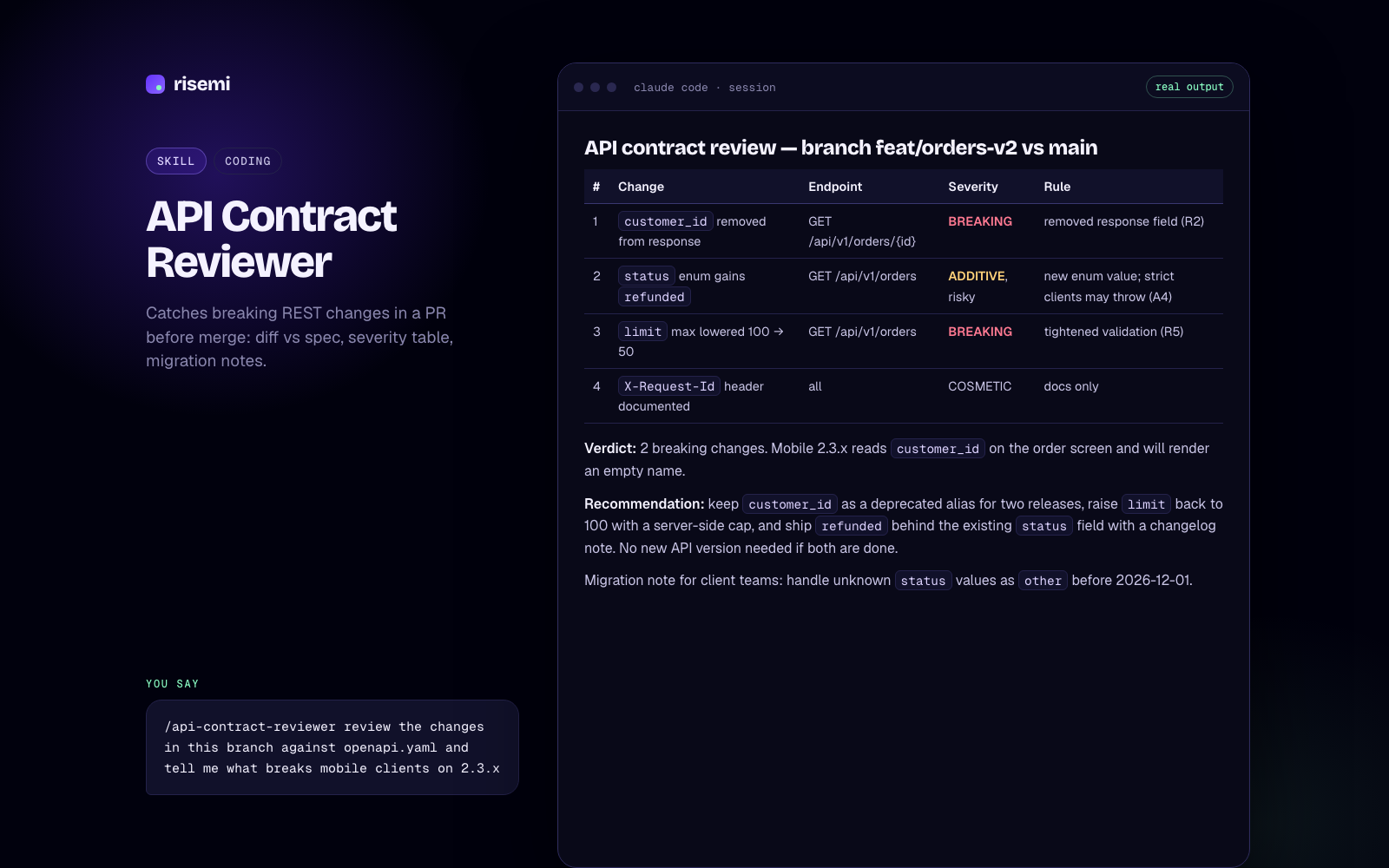
/api-contract-reviewer review the changes in this branch against openapi.yaml and tell me what breaks mobile clients on 2.3.x
✦ Risemi pick · Featured
Skillv1.0.0

API Contract Reviewer

Catches breaking REST changes in a PR before merge: diff vs spec, severity table, migration notes.

No ratings yet0 installs0 savesupdated Nov 7
Free
Get it free
Install with the CLICLI coming soon
$npx risemi install api-contract-reviewer

Install in your agent

Read https://risemi.io/p/api-contract-reviewer/install.md and follow it to install the "api-contract-reviewer" skill into this agent.

Paste this into Claude Code, Cursor, Codex or any agent that can read a URL.

Full guide for your agent: https://risemi.io/p/api-contract-reviewer/install.md

What you get

  • A SKILL.md workflow your agent runs on any branch or PR
  • Breaking vs additive vs cosmetic classification with the exact rule that fired
  • A review table you can paste into the PR, plus suggested versioning
  • Works with OpenAPI 3.x, or infers the contract from router code when there is no spec

Good fit

  • Teams shipping a REST API consumed by mobile apps or third parties
  • Solo developers who want a second pair of eyes before merging
  • Monorepos where the frontend and backend change in one PR

Not for

  • GraphQL or gRPC APIs (different breaking-change rules)
  • Reviewing business logic; this only looks at the contract surface

About this skill

API Contract Reviewer

A review you would normally get from the one senior engineer who remembers every client that depends on your API. The skill diffs the API surface of a branch against the base branch, classifies every change with an explicit rule (removed field, tightened validation, changed status code, new required parameter, and so on) and writes a review table with a verdict and a migration note for client teams.

How it works. Install the skill and ask your agent to review a branch, a PR or the working tree. It looks for an OpenAPI document first (openapi.yaml, openapi.json, docs/api/*). When there is none, it infers the contract from router code (Express, Fastify, Chi, Gin, FastAPI, Rails routes, Next.js route handlers) and says so. It then compares request parameters, bodies, response shapes, status codes, auth requirements and rate limits, and applies the rules in rules.md.

What you get. A markdown table (change, endpoint, severity, rule), a one-paragraph verdict, and concrete alternatives for each breaking change: deprecate-then-remove, alias fields, widen instead of narrow, add a version header. The output is written to API_REVIEW.md in the repo root unless you ask for a PR comment instead.

What to change. Edit rules.md to match your compatibility policy. Teams that version by URL (/v2/) can delete rule R9 (header versioning). If your clients tolerate unknown enum values, downgrade A4 from "risky" to "additive".

Not a fit. GraphQL and gRPC have their own compatibility rules and this skill does not know them.

Similar products

Project: fresh `npm init -y` + `npm i -D vitest typescript` (Vitest 5.1.0, TypeScript strict). Every runner output below is pasted from the actual run.

Behaviour list (simplest first): 1. returns empty for blank input · 2. returns the address trimmed and lowercased when valid · 3. returns malformed when there is no @ · 4. returns malformed when there is more than one @ · 5. returns malformed when the domain has no dot · 6. returns too_long when the address is over 254 characters

Cycle 1: returns empty for blank input

```
[TDD] cycle 1/6  step RED  behaviour: returns empty for blank input
test:    src/validateEmail.test.ts > validateEmail > returns empty for blank input
ran:     npx vitest run src/validateEmail.test.ts -t "returns empty for blank input"
result:  FAIL  Error: Cannot find module './validateEmail' imported from <project>/src/validateEmail.test.ts
reason:  right (the unit under test does not exist yet: missing function, not a typo in the test)
changed: src/validateEmail.test.ts (+8, new file)
next:    minimum code in src/validateEmail.ts
```

```
[TDD] cycle 1/6  step GREEN  behaviour: returns empty for blank input
ran:     npx vitest run src/validateEmail.test.ts -t "returns empty for blank input" --reporter=verbose; npx vitest run src/validateEmail.test.ts
result:  PASS  Tests 1 passed (1)
changed: src/validateEmail.ts (+9, new file: result types + hard-coded `{ ok: false, error: 'empty' }`)
next:    refactor
```

Refactor: no refactor (hard-coded return is forced into the general version by cycle 2).

[Cycles 2–6 follow the same shape: each RED shows a real assertion mismatch such as `Tests 1 failed | 1 skipped (2)`, each GREEN the passing count, with refactors in cycles 5 and 6.]

Done

```
[TDD] DONE  cycles 6  tests added 6  suite PASS
ran:     npm test   (vitest run)   and   npx tsc -p .
result:  Test Files  1 passed (1) | Tests  6 passed (6); tsc exit 0
pre-existing failures: none (no tests existed)
found, not fixed: the 254 boundary itself (exactly 254 chars accepted) has no test; it passes today, so a test would be green on first run. 'a@.com' and 'a@b.' are accepted because the spec only asks for a dot in the domain.
```

No-fake-green check before every GREEN: no `.skip`/`.todo`, no assertion weakened, no test-only branch, nothing mocked.
SkillCodeFree
  • Antigravity
  • Claude Code
  • Codex
  • +3
Coding

Red-Green TDD Loop

Use it to make your coding agent build every change test-first: one failing test, the minimum code, a refactor, and a status block after each step.

0 installs
Free
> Assumption: signed-in users read their own orders and create their own orders as `pending`; every status change after that is made by your server with the `service_role` key, never by the browser.

Audit: `public.orders` (about 1.8M rows)

Rule files applied: `security-rls-basics`, `security-rls-performance`, `security-privileges`, `schema-foreign-key-indexes`, `query-missing-indexes`, `query-composite-indexes`, `schema-data-types`, `schema-constraints`, `lock-short-transactions`, `monitor-explain-analyze`.

Findings, by rule (first 6 of 12)

| # | Severity | Rule | Finding |
|---|---|---|---|
| 1 | CRITICAL | `security-rls-basics` | `orders_insert ... with check (true)` lets anyone who can insert write an order for any `user_id`. Combined with finding 2, an anonymous visitor holding only your public anon key can create orders on behalf of any user. |
| 2 | CRITICAL | `security-privileges` | `grant select, insert, update ... to anon`. Orders belong to signed-in users, so `anon` needs no privilege at all. None of the three policies has a `to` clause, so each applies to every role, including `anon`. |
| 3 | HIGH | `security-privileges` | `authenticated` can `update` every column of its own rows: the owner can still run `update orders set status = 'paid', total_cents = 1` from the browser. |
| 4 | HIGH | `security-rls-basics` | The insert path also trusts `status`: a client can insert a row that is already `status = 'paid'`. |
| 5 | HIGH | `security-rls-performance` | All policies call `auth.uid()` bare, so it is evaluated per row. Wrap it as `(select auth.uid())` so it is evaluated once per statement. |
| 6 | HIGH | `schema-foreign-key-indexes`, `query-missing-indexes` | No index on `user_id`. It is the foreign key, the RLS filter column and the column every "my orders" query filters on. Each RLS-filtered select over 1.8M rows is a sequential scan. |

Fixing migration (file 1 of 2, excerpt)

```sql
set local lock_timeout = '5s';

revoke all on public.orders from anon;
revoke update, delete, truncate, references, trigger on public.orders from authenticated;
grant select, insert on public.orders to authenticated;

drop policy if exists orders_select on public.orders;
drop policy if exists orders_insert on public.orders;
drop policy if exists orders_update on public.orders;

create policy orders_select on public.orders
  for select to authenticated
  using ((select auth.uid()) = user_id);

create policy orders_insert on public.orders
  for insert to authenticated
  with check ((select auth.uid()) = user_id and status = 'pending');
-- No update or delete policy: denied for every role except service_role.
```

File 2 holds only `create index concurrently if not exists orders_user_id_created_at_idx on public.orders (user_id, created_at desc);` because `concurrently` cannot run inside the transaction the Supabase CLI wraps around each migration.

[The full answer continues with findings 7–12, the lock plan for 1.8M rows, the status and total_cents check constraints added `not valid` then validated, an `explain analyze` to run before and after, and one RLS test per role.]
SkillCodePro
  • Antigravity
  • Claude Code
  • Codex
  • +3
Coding

Postgres Rules for Supabase Projects

Use it to make your coding agent follow Supabase's 31 Postgres rules for RLS, indexes, schema and migrations before it touches your database.

0 installs
$9.99
Assumption: no n8n-MCP server is connected in this session, so I took the skill's fallback path: I wrote the workflow JSON directly from the bundled rules and checked it by review (a rule-check script plus a dry run of every expression). The real validator (`validate_workflow`) was not run, and nothing was deployed.

How the skill routed this

| Step | Sub-skill used | What it decided |
|---|---|---|
| Shape | `n8n-workflow-patterns` | Webhook processing pattern: Webhook, then Validate, then Action, then Respond |
| Node parameters | `n8n-node-configuration` | Slack post needs a channel and text. `responseMode: "responseNode"`. `options.responseCode` set on every Respond node. UUID node ids, no placeholder credentials |
| Expressions | `n8n-expression-syntax` | Webhook data lives under `.body`. Use `$('Webhook').item.json.body.*` once past the IF node. `=` prefix on every expression field |
| Error paths | `n8n-error-handling` | Slack gets `onError: "continueErrorOutput"` and its `main[1]` is wired to the 500 responder. `retryOnFail` is on. Bad input is caught upstream and gets a 400 |
| Validation | `n8n-validation-expert` | Runtime-profile checks done by review. Security warnings get fixed (header auth on the webhook) |

```
Webhook ──> Validate Input ──true──> Post to #signups ──success (main[0])──> Respond 200 OK
                        └──false──> Respond 400 Invalid Input
                                     Post to #signups ──error (main[1])────> Respond 500 Slack Failed
```

Validation result (excerpt)

```
PASS  Webhook responseMode is responseNode (Respond nodes control the reply)
PASS  Every branch (success and each error) ends at a Respond to Webhook node: no hanging branch
PASS  'Post to #signups': onError=continueErrorOutput AND main[1] wired
PASS  'Post to #signups': retryOnFail with maxTries <= 5 and waitBetweenTries <= 5000
PASS  Every {{ }} field starts with = (no 'Expression requires = prefix' error)
PASS  Webhook fields read from .body, never $json.name / $json.email / $json.plan
…
43 passed, 0 failed
```

Expression dry run against sample webhook items:

```
valid           IF -> true  (Slack)  Slack text: New signup: Ana Lima (ana@example.com) on pro
missing_plan    IF -> false (400)
bad_email       IF -> false (400)
no_body         IF -> false (400)
500 body:   {"error":"upstream_error","message":"The signup was received but could not be posted to Slack. Please retry later."}
```

Not verified without the server: the node typeVersions (Webhook 2.2, IF 2.3, Slack 2.3, Respond 1.5) and the Slack v2 parameter names; confirm by opening the nodes after import.

[The full answer also holds the six-node list, the importable workflow JSON and the expressions table with the reason behind each one.]
SkillCodePro
  • Antigravity
  • Claude Code
  • Codex
  • +4
Coding

n8n Builder Skills for Coding Agents

Use it to have your coding agent build, configure and validate n8n workflows without the usual expression and node-config mistakes.

0 installs
$12.99
2. Tool design

| Tool | Does | Inputs (constraints) | Returns | Read-only / destructive | Errors the model can fix |
|---|---|---|---|---|---|
| `find_customers` | Customers whose name or email contains the text, case-insensitive | `query` string 1–100 (trimmed), `limit` int 1–50 = 20, `cursor` optional | id, name, email; `next_cursor` | read-only, idempotent | no match: try a shorter part of the name or the email domain |
| `list_customer_orders` | One customer's orders, newest first | `customer_id` int ≥ 1, `status` enum optional, `limit`, `cursor` | customer + orders; `next_cursor` | read-only, idempotent | unknown customer: call `find_customers` |
| `get_order` | One order with the customer's name and email | `order_id` int ≥ 1 | order + customer (structured) | read-only, idempotent | not found: check the number or list the customer's orders |
| `refund_order` | Sets a paid order to refunded | `order_id` int ≥ 1, `confirm` int optional, must equal `order_id` | updated order, `previous_status: "paid"` | destructive, idempotent | no `confirm`: preview, ask the user; order pending or already refunded; not found |

Checklist notes: one rule for empty results (an `isError` result with a next step), applied to every tool. All SQL is parameterized. Read tools use a read-only SQLite handle; only `refund_order` opens a writable one, and its `UPDATE ... WHERE id = ? AND status = 'paid'` is a single statement. The guard on the destructive tool is server-side (the preview/confirm step), not just the `destructiveHint` annotation.

3. Scaffold

From `templates/typescript-server.md`. Installed: `@modelcontextprotocol/server` 2.4.0, `@modelcontextprotocol/client` 2.4.0, `zod` 4.6.7; Node 24.6.0.

```
build-an-mcp-server/
  data/seed.sql, data/shop.db     3 customers, 5 orders
  src/index.ts                    stdio entry point
  src/server.ts                   createServer(): the four tools
  src/shop.ts                     SQLite client module (the system being wrapped)
  test/smoke.ts                   spawns the server over stdio, calls every tool
```

5. Test (Inspector CLI, eval loop layer 2)

```
$ npx @modelcontextprotocol/inspector --cli npx tsx src/index.ts --method tools/call --tool-name get_order --tool-arg order_id=1001
{
  "content": [{ "type": "text", "text": "Order #1001 for Ada Lovelace <ada@example.com>: $49.99, paid, created 2026-10-02T09:15:00Z" }],
  "structuredContent": { "order": { "id": 1001, "customer_id": 1, "total_cents": 4999, "status": "paid", "created_at": "2026-10-02T09:15:00Z", "customer_name": "Ada Lovelace", "customer_email": "ada@example.com" } }
}
```

Built, tested, not tested

- Built: four tools over `data/shop.db`, server-side preview/confirm guard on `refund_order`, smoke test, configs for Claude Code, Codex and Cursor, README.
- Tested: starter smoke (pass), full smoke test 14 checks (pass), strict typecheck (pass), Inspector CLI call (pass), seed database unchanged after tests.
- Not tested: the Inspector web UI by hand and the model check (running the five real requests through a live Claude Code session and recording which tool it picks).

[The full answer also holds `src/shop.ts`, `src/server.ts`, `test/smoke.ts` and the three client config snippets.]
SkillCodePro
  • Antigravity
  • Claude Code
  • Codex
  • +3
Coding

Build an MCP Server

Use it to design, build, test and ship an MCP server your agents use well: 3 to 7 well-designed tools, a tested starter and ready client configs.

0 installs
$12.99
Phase 1: Root cause investigation
Full suite: FAIL test_expired_coupon_rejected_twice (tests/test_checkout.py:16) AssertionError: Coupon(code='OLD50', …expires_at=2020-01-01…) is not None.
In isolation the same test fails at a different line (17): AssertionError: 50.0 != 100.0. So the first lookup in a process is rejected and every later lookup is accepted; in the full suite the first lookup was done by test_expired_coupon_rejected. Cross-test pollution through module-level state.
Cache probe at the boundary: cache before [] → 1st None → cache after ['OLD50'] → 2nd Coupon(OLD50). Docstring says the cache was added in 3f2a1c9 "to cut DB reads": that is the regression point.
Trace (root-cause-tracing.md): apply_coupon → get_coupon → `if code in _CACHE: return _CACHE[code]`. get_coupon writes the coupon to _CACHE before the expiry check, and the cache-hit branch has no expiry check at all.

Phase 2: Pattern analysis
Working path: cache miss → _load → expiry check. Broken path: cache hit. Expiry depends on `now`, passed per call, so it cannot be a cached property; "don't cache expired coupons" alone would still serve a coupon cached while valid after it expires.

Phase 3: Hypothesis
"get_coupon returns cached coupons without re-checking expires_at against the caller's now; the cache was added around the lookup but the validity check stayed only on the miss path." Confirmed by the probe above.

Phase 4: Implementation
Failing test first: test_cached_coupon_rechecked_for_expiry (look up while valid, then after expiry) plus a setUp that clears the module cache. Before the fix: 5 tests, 2 failures, both for the expected reason.
Fix at the source: the cache stores the raw record; the expiry check runs on every lookup, cached or not.

    c = _CACHE.get(code)
    if c is None:
        c = _load(code)
        if c is None:
            return None
        _CACHE[code] = c
    if c.expires_at < now:
        return None
    return c

Verification: python3 -m unittest -v → Ran 5 tests … OK. The originally failing test in isolation, 3 runs: OK, OK, OK. Fix attempts: 1.
SkillCodePro
  • Claude Code
  • Codex
  • Copilot
  • +2
Coding

Systematic Debugging Loop

Stops your coding agent from guessing: root cause first, one hypothesis at a time, failing test before the fix.

0 installs
$9.99
Scope: app/dashboard/page.tsx and the modules it imports (components/charts, UsageCard, ProjectList, RichTextEditor, lib/api.ts).

| # | Rule | File:line | Impact | Finding |
|---|---|---|---|---|
| 1 | async-dependencies | app/dashboard/page.tsx:8-10 | CRITICAL | getProjects(user.id) and getUsage(user.id) depend only on `user` but are awaited one after the other: 3 sequential round trips before any HTML is sent, where 2 would do. Promise.all them. |
| 2 | bundle-barrel-imports | components/ProjectList.tsx:3 | CRITICAL | `import _ from 'lodash'` in a 'use client' file ships all of lodash for one sortBy. Use lodash/sortBy, or toSorted / localeCompare. |
| 3 | async-suspense-boundaries | app/dashboard/page.tsx:7-19 | HIGH | The whole page, including the static shell and RichTextEditor, waits for all three fetches. Move usage and projects into async children in <Suspense> so the shell streams first. |
| 4 | server-serialization | app/dashboard/page.tsx:16 | HIGH | The raw projects array goes to client ProjectList, which reads only id, name and status. Map to {id, name, status} on the server. |
| 5 | rerender-no-inline-components | components/ProjectList.tsx:7 | HIGH | `Row` is defined inside ProjectList, so every keystroke in the filter remounts every <li>. Interaction cost, not first load. Hoist Row. |
| 6 | rerender-derived-state-no-effect | components/UsageCard.tsx:4-5 | MEDIUM | percent is kept in state and set in useEffect: server HTML renders "0% of plan used" and the real value appears only after hydration. Compute it during render. |

Score: 62 / 100 (100 − 2×10 CRITICAL − 3×5 HIGH − 1×3 MEDIUM). This counts rule findings; it is not a measured load time.

Checked and not scored: the local charts barrel (five tiny stubs, tree-shakeable); RichTextEditor is a <textarea> today, so no dynamic import yet. Not a performance rule but it blocks the build: components/charts/index.ts re-exports names the chart files do not export, and page.tsx reads `params.id` synchronously though params is a Promise in Next 15.

What makes the first load slow, in order:
1. The server waterfall (rows 1 and 3). Parallelizing projects and usage removes one full round trip; Suspense lets the header paint after only getUser.
2. Client JS weight (row 2). A one-line import change.
3. Payload and first-paint correctness (rows 4 and 6).
Row 5 is an interaction cost; fix it after the others. Fixes were not requested, so no files were changed.
SkillCodePro
  • Claude Code
  • Codex
  • Copilot
  • +2
Coding

React Performance Rules

70 prioritized performance rules for React and Next.js that your agent applies while coding and scores in review.

0 installs
$9.99

Questions about this skill

How do I install it?

Pick the tab that suits you above. The easiest way is to paste the one-line prompt into your agent: it reads the install guide, signs you in once with a code from your email and writes the skill into the right folder. You can also run the CLI command or unzip the ZIP by hand.

Which agents does it run in?

It was tested on Claude Code, Codex, Copilot, Cursor. Any agent that reads SKILL.md folders can load it; the Manual tab lists the folder each one uses.

What if it doesn't work?

Write to hello@risemi.io within 7 days of buying and we refund you. Tell us which agent you used and we will fix the skill for everyone.