
Prompt packTextPro
- ChatGPT
- Claude
- Gemini
Marketing✦ Risemi pick
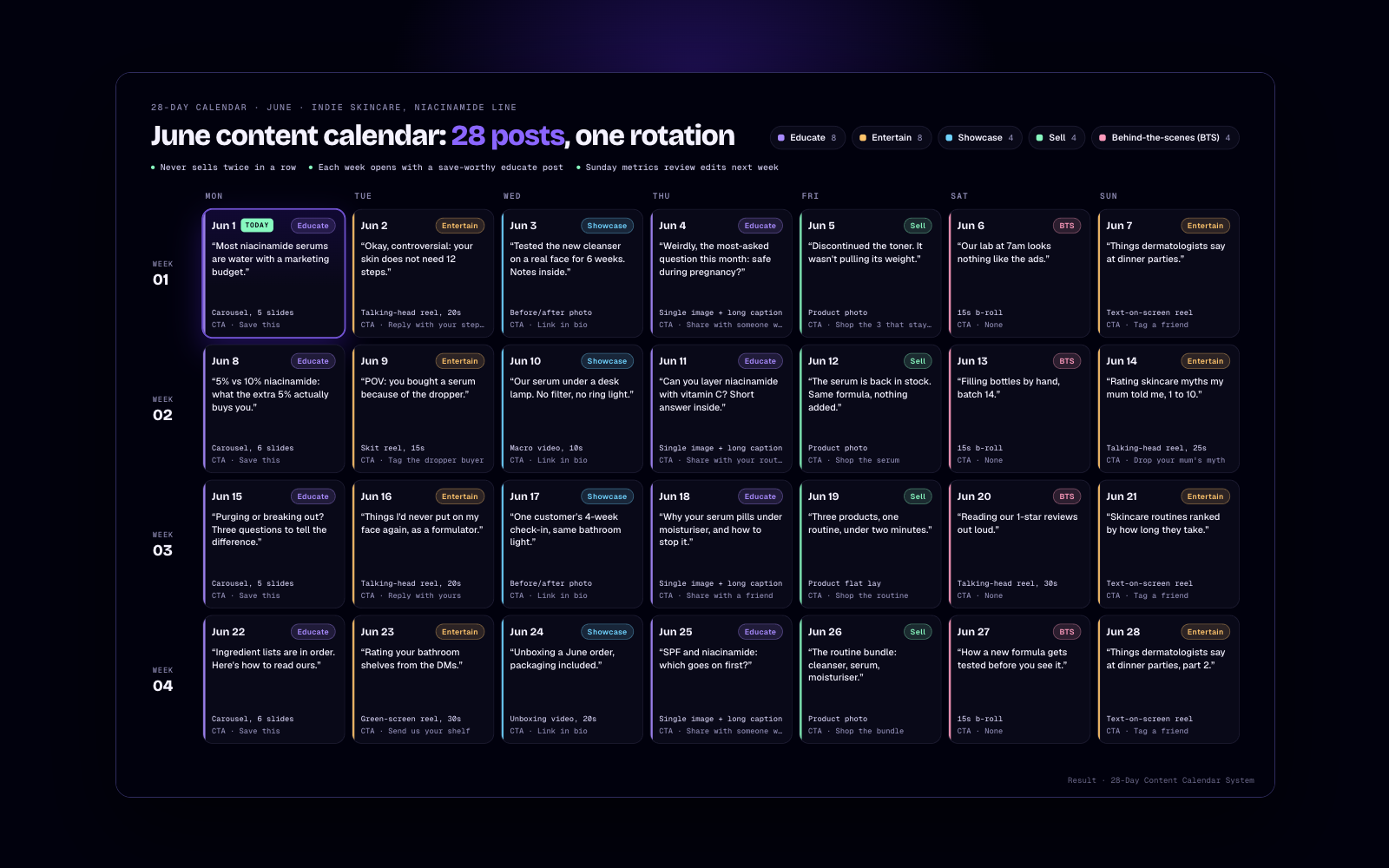
28-Day Content Calendar System
Eleven chained prompts: brief, voice, pillars, hooks, four-week calendar, daily captions, weekly review.
0 copies
$9.9918 results
Eleven chained prompts: brief, voice, pillars, hooks, four-week calendar, daily captions, weekly review.
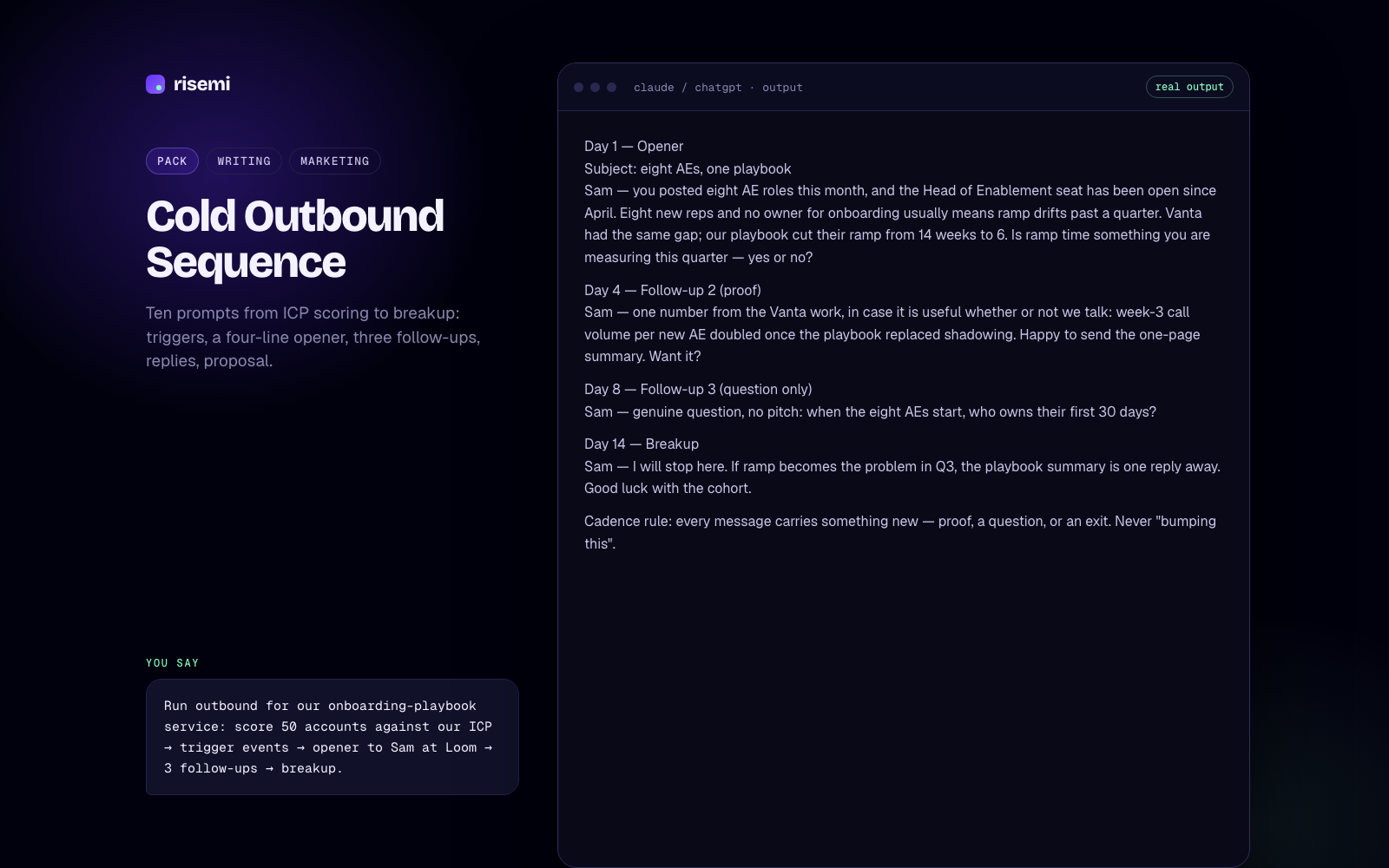
Ten prompts from ICP scoring to breakup: triggers, a four-line opener, three follow-ups, replies, proposal.
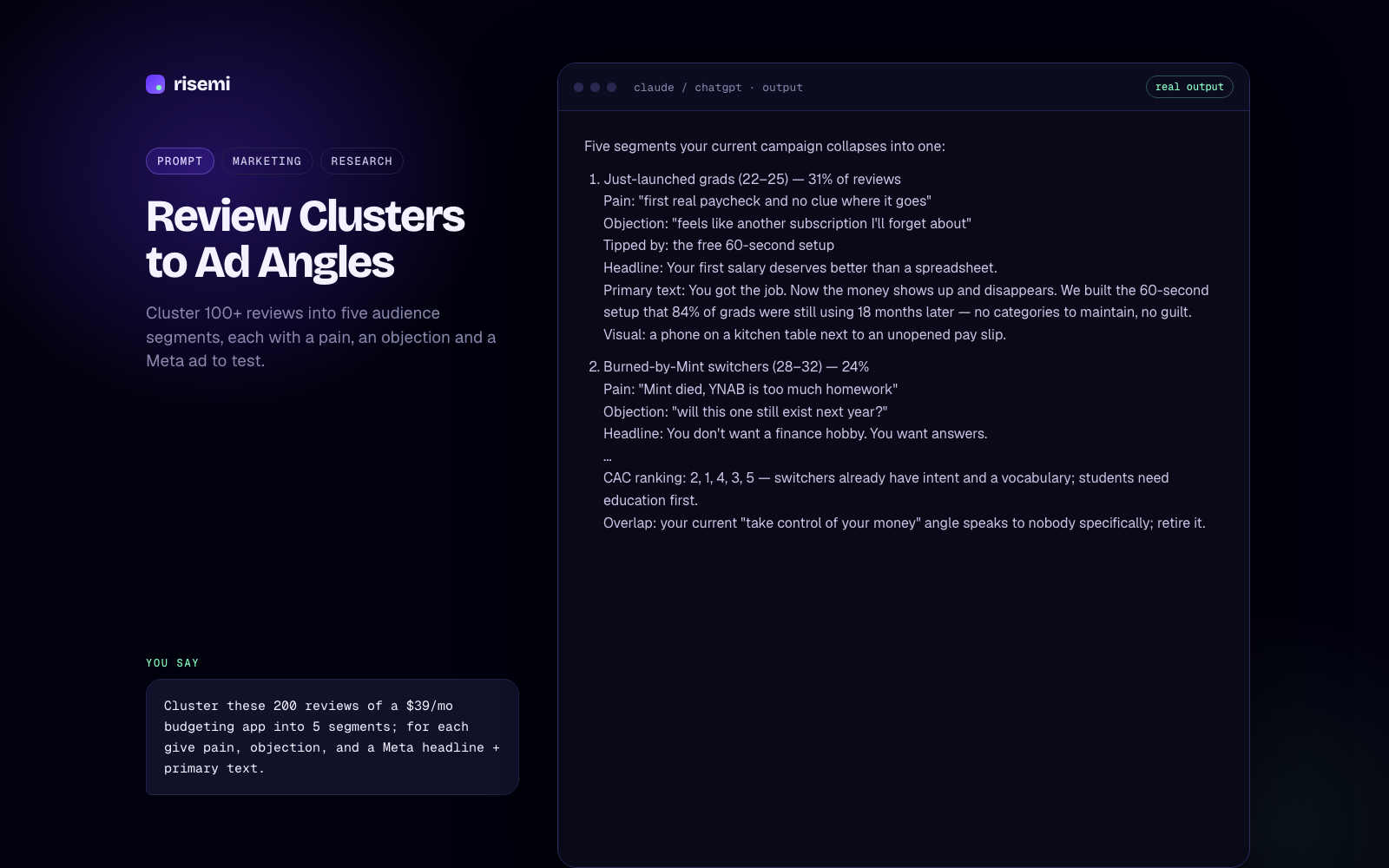
Cluster 100+ reviews into five audience segments, each with a pain, an objection and a Meta ad to test.
Use case: Product teaser (template 1)

| Element | Value |
|---|---|
| Subject | A matte black ceramic pour-over coffee dripper with a thin polished copper rim, sitting on a clear glass carafe |
| Action | 1) A thin stream of dark coffee trickles from the dripper into the carafe while soft steam curls up from the rim; 2) the dripper and carafe turn a slow quarter turn; 3) the final second holds still on the dripper's front, copper rim catching the light |
| Scene | A walnut kitchen counter by a window, early morning just after sunrise, a faint haze of steam in the air, uncluttered background |
| Angle / Move | Vertical close-up at counter height, slightly above eye level / slow dolly in |
| Lens | 85mm-style telephoto feel, shallow depth of field, kitchen background in soft bokeh |
| Light / Palette / Mood | Soft low-angle morning sunlight from a window on the left with gentle fill and a warm rim on the copper / matte black, warm copper, honey-brown walnut, soft cream highlights / calm, quiet, unhurried |
| Style / Time | Premium commercial look, photorealistic / real-time pace, steady trickle throughout, still hold in the last second |
| Audio | Close, clear coffee trickling into glass, a faint soft drip, quiet low morning room tone, no music |
| Negative | text, logos, letters, labels, hands, people, clutter, reflections of people, plastic look |

Final prompt (paste into Veo / Gemini / Flow):

Premium commercial look, photorealistic, vertical close-up at counter height of a matte black ceramic pour-over coffee dripper with a thin polished copper rim, sitting on a clear glass carafe on a walnut kitchen counter by a window in the early morning just after sunrise. A thin stream of dark coffee trickles from the dripper into the carafe while soft steam curls up from the rim, and the dripper and carafe turn a slow quarter turn. Slow dolly in, 85mm-style telephoto feel, shallow depth of field with the kitchen background in soft bokeh. Soft low-angle morning sunlight from a window on the left with gentle fill and a warm rim light catching the copper, palette of matte black, warm copper, honey-brown walnut and soft cream highlights, calm and quiet mood. Real-time pace; the final second holds still on the dripper's front.
Audio: close, clear sound of coffee trickling into a glass carafe, a faint soft drip, quiet low morning room tone, no music.
Negative prompt: text, logos, letters, labels, hands, people, clutter, reflections of people, plastic look

Settings: 9:16, 8 seconds, audio on.
Use it to turn a rough video idea into a structured Veo prompt with a filled anatomy table, camera, lens, light, audio and a negative prompt.
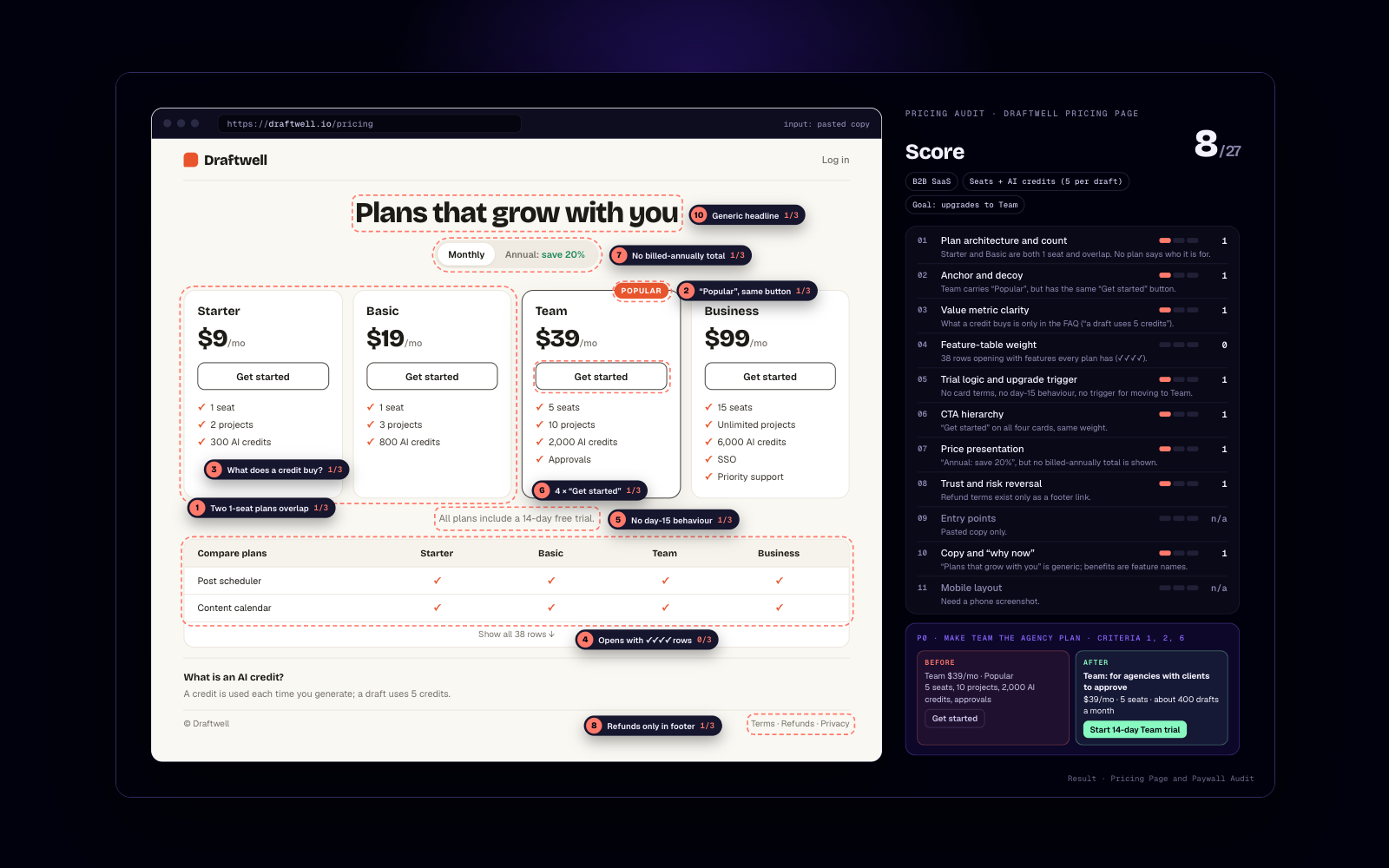
Use it to score a pricing page or in-app paywall on eleven criteria and get three ranked fixes with rewritten copy and one experiment to run.
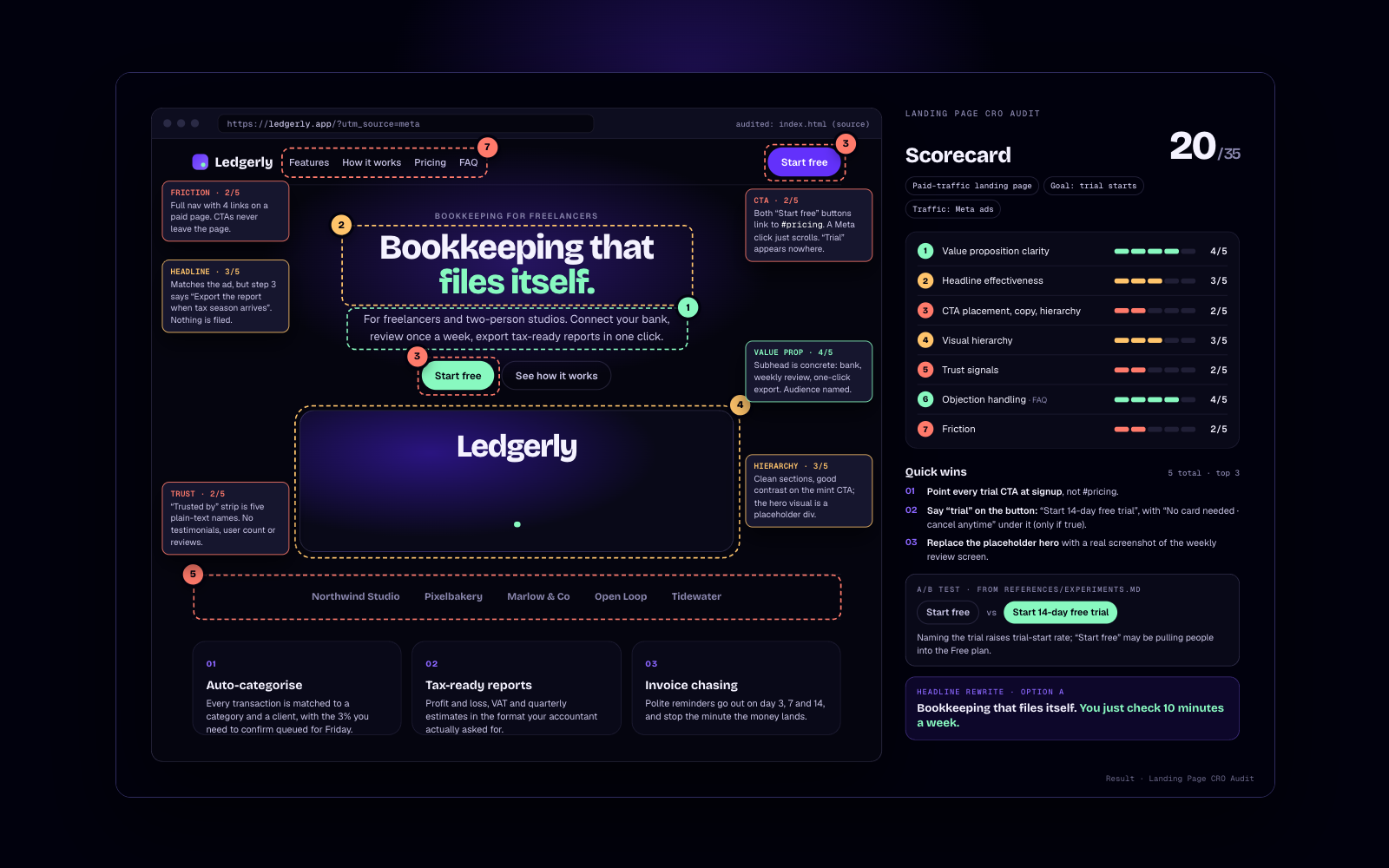
Audit a live page that isn't converting: a 7-point scorecard, quick wins, test ideas and before/after copy.
Short answer: ChatGPT can't recommend Ledgerly, because nothing it can retrieve says Ledgerly exists. Even after launch, a single landing page is not enough. A "best X for Y" shortlist comes from web-wide consensus (reviews, roundups, forums, press), not from your own site.

Visibility ladder (retrieved → cited → mentioned → recommended)
| Rung | Ledgerly today | What governs it |
|---|---|---|
| 1. Retrieved | No: not live, not in Bing's index (ChatGPT search draws from a Bing-based index) | Being indexed and crawlable |
| 2. Cited | No | Extractable, factual, fresh pages |
| 3. Mentioned | No | Entity recognition; the web talking about you |
| 4. Recommended | No | Aggregate third-party consensus, largely independent of your own content |

Source pool (one web search for the exact query, 2026-11-07; not a ChatGPT answer): only third-party roundups and affiliate lists (NerdWallet, business.org, Zapier, Fueler, Techjockey, Aspire). The same five apps recur: Wave, Zoho Books, FreshBooks, QuickBooks, Xero. I did not run ChatGPT, so I'm not reporting what ChatGPT says; run the query list yourself.

Extractability check on site/index.html: clear definition in the first paragraph, partial (the H1 is a slogan); self-contained answer blocks, fail; statistics with sources, fail; comparison table for "vs" queries, fail; FAQ, partial (good answers hidden in collapsed <details>, none answers "Is Ledgerly good for freelancers?"); schema markup, fail; author or founder, fail; freshness date, fail; query-shaped headings, fail.

Top fixes, by impact against effort
1. Launch, then get indexed in Bing and Google. robots.txt with a wildcard allow plus explicit allows for OAI-SearchBot, PerplexityBot, Claude-SearchBot and Bingbot; decide training crawlers (GPTBot, ClaudeBot) separately.
2. Seed third-party consensus: G2 and Capterra listings with the first 20–30 real reviews; pitch the roundups that already rank for the query with a specific angle ("$12/month, no per-transaction fees, automatic invoice chasing"). Test: if a model ignored your own domain, would the web still put you on the list? Today, no.
3. Rewrite the hero into an extractable definition (below).
4. Add /vs/freshbooks, then QuickBooks and Wave, in the "fair source" pattern. Do not publish a self-ranked "best bookkeeping apps" listicle: in the skill's data 69% of such citations recommended competitors.
5. Publish /pricing.md and /llms.txt; fix the Studio button ("Talk to us" on a plan with a public price reads as a sales wall to an agent).
6. JSON-LD: Organization, SoftwareApplication with Offer per plan, FAQPage.
7. Buyer-intent FAQs rendered open in the HTML. 8. Named founder, "Last updated", one dated sourced number. 9. Measure monthly: 8 queries, 3–5 runs per engine, log rung and framing.

Hero answer block (57 words, every fact from the existing page):
> Ledgerly is a bookkeeping app for freelancers and two-person studios. It connects to your bank through Plaid or TrueLayer (US, UK, EU), auto-categorises each transaction by category and client, chases unpaid invoices on day 3, 7 and 14, and exports tax-ready P&L, VAT and quarterly estimates. Free plan available; Pro is $12/month with no per-transaction fees. […]Get cited in AI Overviews, ChatGPT and Perplexity: visibility audit, crawler check, ranked fixes, answer-block rewrites.
HERO HEADLINE VARIANTS — current: "Smart plant care, powered by AI"

1. Pain framing — "Your fiddle leaf is not dying. It is asking for one thing." (lever: pain)
2. After-state — "Know what your plant needs before the next leaf drops." (lever: outcome)
3. Specificity — "Diagnose yellow leaves in 2 minutes from one photo." (lever: specificity)
4. Contrast — "Every blog says something different. Your plant says one thing." (lever: pain)
5. Number — "4 days. That is how long you have after the first leaf drops." (lever: specificity)
6. Confession — "We built this after killing nine plants in one apartment." (lever: proof)
7. Command — "Stop watering on a schedule. Start reading the leaves." (lever: after-state)
8. Reader quote — "I did not do anything wrong — I just was not told." (lever: voice)
9. Question-free curiosity — "The third thing nobody mentions about overwatering." (lever: specificity)
10. Promise — "Your next plant survives. This one might too." (lever: outcome)

Test first: #2 against #3 — same lever family, different specificity; the winner tells you whether the audience wants reassurance or precision.
Ten prompts from customer research to an assembled page: promise, hero, problem, proof, FAQ, pricing.
Validation page — "Stop reinventing your client kickoff every Monday."

Promise bullets:
- 12 Figma templates that map to the briefs clients actually send
- A Notion brief generator: 4 questions in, a fillable scope out
- A 9-question client questionnaire that ends the "can you just tweak this?" loop

Objection handler: "Not a course. Not a community. Just the four files you wish someone had given you in year one."
CTA: "Pre-order for $49 — ships in 14 days. Refund if you don't use it."

Red team (as an investor who watched ten of these fail): the failure mode you are underestimating is not demand, it is the second purchase. Templates sell once; the Notion generator is the only piece with a reason to come back. Measure: of the first 50 buyers, how many open the generator twice in 30 days. If under 20%, the next product is a generator, not more templates.

Milestone 1 — validation page live · acceptance: 25 pre-orders in 7 days from $100 of ads and 20 DMs.
Ten prompts from promise to week-one retro: validation page, pricing, red team, announcement, teaser.
BRAND BRIEF — Northwood Beard Oil

1. Positioning
We help men 28–45 with full beards stop smelling like drugstore musk. We can do this because a third-generation perfumer blends 14 natural notes other beard brands will not pay for.

2. Audience snapshot
- Situation: has worn the same $9 oil for years; wife or colleague has commented on the smell
- Trigger: a wedding, a new job, or the bottle running out
- Tried: "premium" brands that still lean on synthetic musk
- Fears: smelling like a teenager's locker; paying $40 for marketing

3. Promise
A scent people ask about, not one they step away from — within the first week.

4. Voice rules
Do: short declaratives ("Three notes. Zero musk.") / Don't: "elevate your grooming ritual"
...
6. Instruction for future prompts
Use this brief. Never use "elevate", "curated", "ritual". Always name a specific scent note.

Skeptic re-read: "Third-generation perfumer" is doing all the work — if it is not provable on the site, the positioning collapses to "nice smell". Holds only with proof.The brief you paste on top of every marketing prompt for a year: positioning, audience, promise, voice.
PILLAR — "The async standup playbook: how 14 distributed teams dropped the 9 AM call"
Keyword: async standup (~1,900/mo) · Intent: informational, late-stage
Gap in current top results: none give a template by team size; all assume 5–8 people.
H2s: Why the sync standup breaks past 3 time zones / The 3 formats by team size / Slack + Notion templates / What to do when nobody posts / Daily vs weekly / Tools compared honestly

Supporting articles
1. "Async standup template (Slack and Notion versions)" — async standup template (~720) · transactional · links to H2 #3
2. "Why your async standup is being ignored — and the 3-line fix" — async standup not working (~210) · informational · H2 #4
3. "Daily or weekly async standup for a 6-person team?" — daily vs weekly standup (~140) · comparison · H2 #5
4. "Async standup across 5+ time zones: what actually works" — async standup timezone (~95) · informational · H2 #1
...
Publishing order: 1, 2, 4 first (quick wins, low competition), pillar in week 3, remaining support weeks 4–6.
One pillar page plus eight supporting articles, each a real search question with keyword, intent and link map.
Ranked causes

1. Creative launch pushed spend into a worse-converting audience (fit: HIGH)
Mechanism: three new creatives entered learning Monday; Meta over-delivers early impressions to cheap, low-intent placements.
Supports: spike begins the same day; recovery by Sunday matches a 5–7 day learning window.
Contradicts: nothing in the inputs — but you have not split CAC by creative yet.

2. Competitor promo raised auction prices Tue–Thu (fit: MEDIUM)
Supports: Tuesday start; CPM data would show it.
Contradicts: the spike started Monday, a day before the promo.

3. +30% budget scale on the top campaign reset learning (fit: MEDIUM-LOW)
Supports: scaling same day. Contradicts: a 30% step rarely resets learning on its own.

Next data cut: CAC and CPM by creative, by day, Mon–Sun. If the three new creatives carry a CAC over $90 on Mon–Wed while legacy creatives stay near $48, cause 1 is confirmed.

Not considered: a tracking gap — check whether the pixel fired normally Mon–Wed before trusting any of this.
Do not: pause the new creatives today. You would destroy the data that tells you which of them is fine.
Three ranked causes for a metric anomaly, the one data cut that confirms the top cause, and what not to do.
VOICE OF CUSTOMER — GrowNest (30 reviews, App Store, 3 competing apps)

Top 5 pains
1. "it was fine in the shop and now it's dropping leaves" (11)
2. "I can't tell if I'm overwatering or underwatering" (9)
3. "every blog says something different" (7)
4. "the reminders nag me but never tell me why" (5)
5. "I've killed three of these already" (4) — EARLY SIGNAL: one reviewer, "I'd honestly given up on plants"

Top 5 dream outcomes
1. "finally know what's wrong before it's too late" (8)
2. "it just told me: less water, more light. done." (6)
3. "my monstera actually grew a new leaf" (5)
...
Recurring words: dropping, yellowing, overwatering, "no idea", nag, finally, survive, confident, "too late", simple
Words to avoid: ecosystem, curated, holistic, "plant parent", elevate
Turn 30+ reviews into a one-page brief of pains, outcomes and objections in the customer's exact words.
Subject: Your pricing page is lying to you
Preview: Three founders raised prices last month. Two regret it.

Headline: The pricing change that costs more than it earns

1. The claim — Raising prices 20% sounds like free margin. For two of three founders I spoke to this month it cut net revenue, because the churn arrived three months later and nobody connected it.
2. The mechanism — Annual customers do not leave on day one. They leave at renewal, which is after you have already celebrated.
3. The numbers — Founder A: +20% price, −11% net revenue by month 5. Founder B: +15%, +9% — the difference was a grandfather clause.
4. What I would do — Raise for new customers only. Measure renewal cohorts for two quarters before touching existing plans.

CTA: Reply with your last price change and the month you measured it. I will tell you if you measured too early.

Cuts the author will push back on: the opening anecdote about the coffee shop (300 words, no number); the second example that repeats the first; "I think" ×6.
Cut a newsletter issue by a quarter, sharpen the hook and the close, and keep every number and opinion.
Voice rules

- Sentence length: 4–10 words. Never a sentence over 14.
- Tone: dry, mildly self-deprecating, never preachy. "Okay, controversial:" / "Weirdly, the most-asked question this month" / "Sorry. Also not sorry."
- Words used often: actually, okay, weirdly, notes inside, for a real face
- Words never used (peers use them): journey, elevate, unlock, glow-up, self-care, ritual, holy grail, obsessed
- Emoji: one at the end, never mid-caption. 🌿 or 😌.
- Hooks: a contrarian observation stated flat, never a question.
- Closes: one short verdict, no CTA.

New captions (launch week)
1. Most niacinamide serums are water with a marketing budget. Ours isn't. 🌿
2. Okay, controversial: your skin does not need 12 steps. It needs 3 that work.
3. Tested the new cleanser on a real face for 6 weeks. Notes inside.
4. Weirdly, the most-asked question this month: "safe during pregnancy?" Yes.
5. Discontinued the toner. It wasn't pulling its weight. Sorry. Also not sorry. 😌
...
Drift check: #7 uses a question hook; #9 runs 16 words. Cut both.
Extract your writing voice from ten posts, then draft new captions a long-time follower could not tell apart.
1. Three weeks ago it was perfect. Now it loses a leaf every other day.
2. The plant in the shop window is not the one in your living room.
3. You did not do anything wrong. Nobody told you the one thing it needs.
4. It is not the light. It is not the water. It is the third thing.
5. Day 21: the soil is wet, the leaves are yellow, the blog says "just wait".
6. Confession: I killed four of these before I learned to read the leaves.
7. Your plant has been asking for help for two weeks. You just did not speak the language.
8. 80% of dropped leaves come from the same two mistakes. Both are fixable tonight.
9. Still watering on a schedule? That is the thing killing it.
10. The nursery tag said "easy". The nursery tag lied.

Cold landing page: #2 — the contrast is visual and lands in one read.
Warm email: #3 — removes blame, which is what a subscriber who already feels guilty needs first.
Ten problem-agitate-solve hooks for one specific reader, with the best pick for cold and warm traffic.
Subject: eight AEs, one playbook

Sam — you posted eight AE roles this month, and the Head of Enablement role is still open from April.
Eight new reps and no owner for onboarding usually means ramp drifts past a quarter while everyone is "about to" write the playbook.
Vanta had the same gap last year; our playbook cut their AE ramp from 14 weeks to 6.
Is ramp time something you are measuring this quarter — yes or no?

— Dana

Backup first line (if the roles are filled by send time): "Saw the eight AEs you hired this spring — congratulations, and sympathies for whoever owns their ramp."
A four-line cold email that opens with one real observation and could not be sent to any other company.
Subject: the 14-week ramp

Sam — on the call you said ramp "is going to kill us by Q2" if the eight new AEs land without a playbook. That line has stayed with me, which is why I am writing rather than waiting.

I know a quiet week usually means priorities moved, not that the problem did.

Two options: A — we start a two-week pilot with the first cohort on Thursday the 19th; B — we park it until the cohort is hired and I check back the first week of July. Reply "A" or "B" and I will handle the rest.

If this is a no, a one-line "not now" is genuinely fine — it lets me stop guessing.

— Dana

LinkedIn version:
Sam — your "ramp will kill us by Q2" line is still on my notepad. Pilot Thursday, or park it till July? A or B is enough.
Re-open a stalled deal by quoting one moment from the call and offering a one-word next step.