
Most AI-written cold email fails for the same reason most human-written cold email fails: it could have been sent to anyone. ChatGPT and Claude are very good at producing fluent, polite, generic paragraphs, and generic is exactly what a busy reader deletes. The fix is not a cleverer model. It is giving the model the one thing it cannot invent, a real reason you are writing to this person now, and then forcing it into a short, rigid shape.
This guide gives you the shape, six prompts you can copy for free, and a list of what to check before anything goes out.
What makes a cold email work
Three rules carry most of the weight.
A trigger event. Something specific happened at the prospect's company: a funding round, a new hire in a relevant role, a pricing change, a job post that reveals a gap, a product launch, a complaint in their reviews. The trigger is your reason for writing, and it is what makes the first line impossible to send to another company. If you cannot name a trigger, you are not ready to email that account.
Four lines. Observation, implication, proof, ask. One sentence each. Readers decide in the preview pane, so anything past four lines mostly exists for you, not them.
One ask. Not "a quick call, or I can send a deck, or happy to connect you with my colleague." One small, easy yes. "Worth a 15-minute look next week?" beats a calendar link in a first touch for most audiences, because it asks for a reply, not a commitment.
A useful test: read your email aloud and ask whether the prospect could guess, from the first line alone, why it landed in their inbox and not someone else's.
Before you prompt: collect the raw material
The model writes from what you give it. For each account you want:
- The trigger, with a link or date
- The prospect's role and what they likely own
- One result you got for a similar company, with a number
- Your ask
If you sell to a market with public reviews (G2, app stores, Amazon, Trustpilot), mine them first. Customers describe their pain in phrases that work far better in outreach than your marketing language. You can do that with a prompt that turns 30 or more reviews into a one-page brief of pains, outcomes and objections, in the customers' own words.
Six prompts you can copy
These work in ChatGPT, Claude or Gemini. Replace everything in square brackets. Paste your facts below the prompt rather than asking the model to look them up, because invented "research" is the most common way AI cold email embarrasses people.
1. Find the trigger worth writing about
I sell [product] to [role] at [type of company]. Below are notes on one account:
news, job posts, LinkedIn activity, website changes.

Pick the single event most likely to create a need for what I sell.
For it, write:
- the event in one sentence, with its date
- why it creates a problem or opportunity for a [role] (one sentence)
- your confidence (high/medium/low) and why

If nothing in the notes is a credible trigger, say so. Do not invent events.

NOTES:
[paste]
2. The four-line first email
Write a cold email to [name], [role] at [company].

Trigger: [event, date]
Their likely problem because of it: [one sentence]
Proof: [a result for a similar customer, with a number]
Ask: [one small ask]

Rules:
- Exactly four sentences: observation, implication, proof, ask.
- First sentence must mention the trigger specifically enough that it could
  not be sent to another company.
- Under 75 words. No greeting line beyond "Hi [name],".
- Plain words. No "I hope this finds you well", no "reaching out",
  no "synergy", no exclamation marks.
- Subject line: 2-4 words, lowercase, no clickbait.

Give me 3 versions that differ in the angle of the implication, not in wording.
3. Rewrite your own draft
Often you already have a draft that is too long. This keeps your facts and cuts the rest.
Here is my cold email draft. Cut it to four sentences
(observation, implication, proof, ask) and under 75 words.
Keep every specific fact and number. Remove anything that talks about us
before it talks about them. Then list what you removed and why.

DRAFT:
[paste]
4. Follow-ups that add something
The usual follow-up ("just bumping this") gives the reader no new reason to reply. Each follow-up should carry one new piece of value.
Write 3 follow-ups to the email below, sent on day 3, day 7 and day 14.
Each must add one new thing: (1) a short relevant data point or example,
(2) a different angle on the same problem, (3) a useful resource with no ask
attached except "want it?".
Max 3 sentences each. Never write "just following up", "bumping this"
or "circling back". Reply in the same thread, so no new subject lines.

ORIGINAL EMAIL:
[paste]
FACTS I CAN USE:
[paste]
5. The breakup email
The last message in a sequence often gets the most replies, because it closes the loop politely and makes a one-word answer easy.
Write a final email to [name] after no replies to [number] messages about
[topic]. Two or three sentences. Assume they are busy, not uninterested.
Offer an easy out and an easy in: ask them to reply with a number,
e.g. "1 = not a priority, 2 = later this year, 3 = let's talk".
No guilt, no sarcasm, no "I'll assume you're not interested".
6. Reply handling
A prospect replied to my cold email with the message below. Classify it
(interested / objection / referral / not now / no) and draft a reply
under 60 words that answers exactly what they asked and proposes one
next step. If it's an objection, name the real concern behind it first,
then draft.

THEIR REPLY:
[paste]
CONTEXT ON MY OFFER:
[paste]
When a warm deal goes quiet
Cold outreach and a stalled deal are different problems. If you had a real call and the prospect went silent, do not send another generic nudge. Quote one specific thing they said on the call, connect it to a single next step, and make the reply a one-word decision. That approach is free to copy as a prompt:
What AI gets wrong in cold email
Even with good prompts, check for these before sending:
- Invented facts. Models will happily write "Congrats on the Series B" for a company that raised a seed round. Only let it use facts you pasted. Prompt 1 tells it to say when nothing qualifies; keep that line.
- Flattery as observation. "I love what you're doing with your brand" is not a trigger. If the first sentence would survive a find-and-replace of the company name, rewrite it.
- Creeping length. Ask for four sentences and you will often get five with a semicolon. Count.
- Stock phrases. "I hope this email finds you well", "I wanted to reach out", "quick question", "game-changing". Ban them in the prompt and still scan for them.
- Too many asks. Models like to offer options. One ask per email.
- Same email, ten prospects. If you batch, compare the outputs side by side. If the middle two sentences are identical across accounts, your implication line is generic.
A last practical point: AI makes it cheap to write, which tempts people to send far more email. Deliverability, sending limits and local rules on unsolicited email (CAN-SPAM in the US, GDPR and PECR in the UK and EU) still apply. Fewer, better-targeted emails usually outperform volume.
Going further: a full sequence
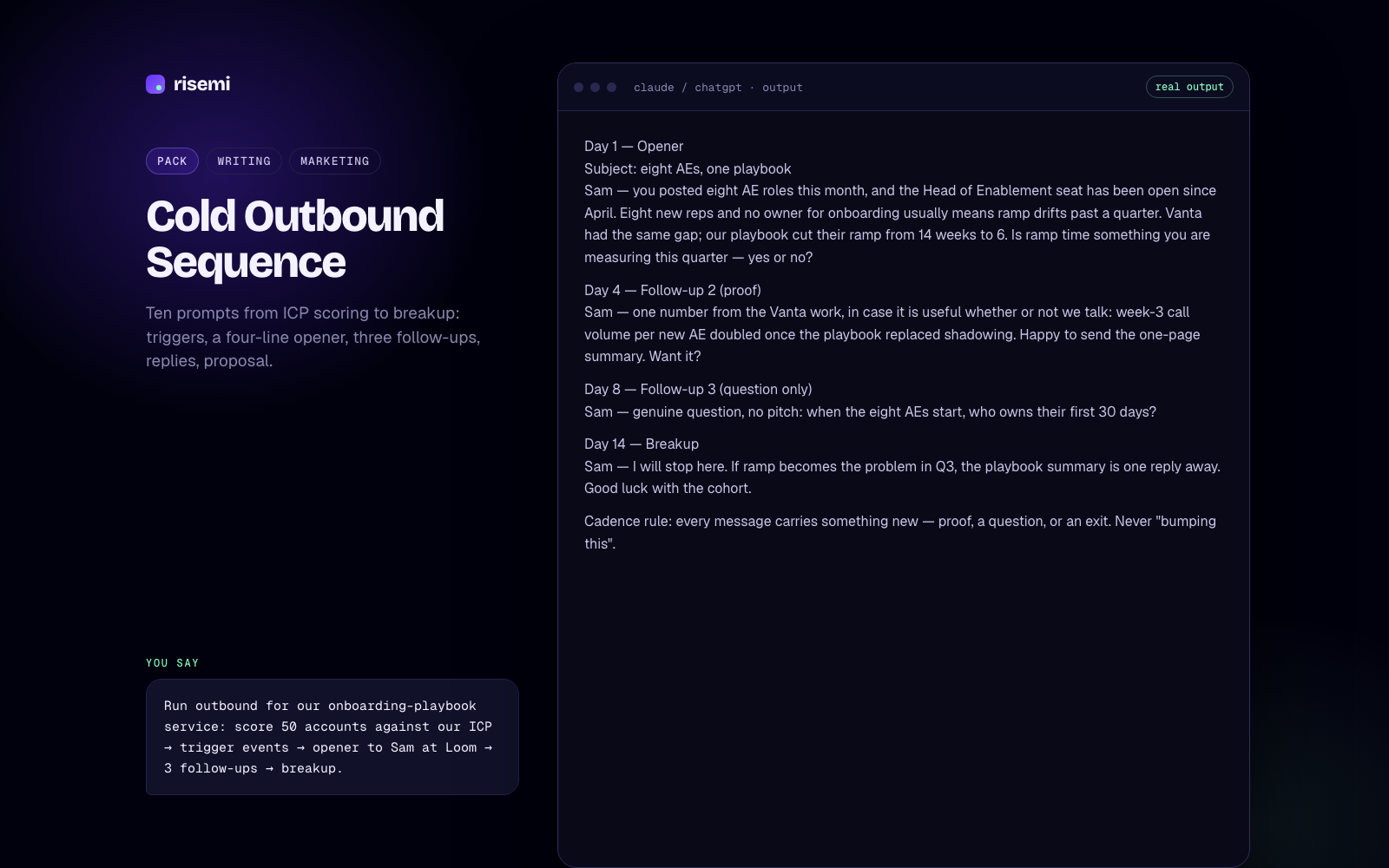
The prompts above cover one account at a time. If you run outbound every week, a chained set is faster: score accounts against your ideal customer profile, pull triggers, write the opener, generate three follow-ups, handle replies, and turn a "yes" into a one-page proposal. That is what these two products do, tested on real campaigns:
Subject: eight AEs, one playbook

Sam — you posted eight AE roles this month, and the Head of Enablement role is still open from April.
Eight new reps and no owner for onboarding usually means ramp drifts past a quarter while everyone is "about to" write the playbook.
Vanta had the same gap last year; our playbook cut their AE ramp from 14 weeks to 6.
Is ramp time something you are measuring this quarter — yes or no?

— Dana

Backup first line (if the roles are filled by send time): "Saw the eight AEs you hired this spring — congratulations, and sympathies for whoever owns their ramp."
- ChatGPT
- Claude
Cold Email Built on a Trigger Event
A four-line cold email that opens with one real observation and could not be sent to any other company.
- ChatGPT
- Claude
Cold Outbound Sequence
Ten prompts from ICP scoring to breakup: triggers, a four-line opener, three follow-ups, replies, proposal.
For more writing and outreach prompts, browse the marketing prompts and founder collections. If you want to turn a prompt like these into a reusable skill your coding agent can run, see how to write a SKILL.md.